
To calculate notice periods, establish service year, receipt date and the default month-end rule after probation. One day late can mean another month’s pay. This guide explains Art. 335c of the Code of Obligations (OR; CO), receipt, variations and extensions.
Statutory notice by service year
Either party may terminate indefinite employment (Art. 335, para. 1 CO). Fixed terms expire without notice (Art. 334, para. 1). After probation, Art. 335c, para. 1 applies:
| Service year | Notice | End date |
|---|---|---|
| 1 | 1 month | Month-end |
| 2–9 inclusive | 2 months | Month-end |
| From 10 | 3 months | Month-end |
During probation, a different statutory rule applies: the notice period is seven days under Art. 335b CO. Establish whether probation has ended before using the service-year table above. The separate guide to Probation explains the rules for that stage of employment.
Count service years correctly
The law refers to service years without defining how to count them. In practice, the first service year begins on the employee’s joining date and ends on the day before the first anniversary. The next service year starts on that anniversary. For someone who joined on 15 August 2017, the ninth service year therefore continues through 14 August 2026, and the tenth begins on 15 August 2026.
Use the service year at the time notice is received, rather than the service year in which employment will end. SECO explains that notice delivered during the first service year carries a one-month period even when that period expires in the second service year. The same principle applies at the boundary between the ninth and tenth service years.
Month-end: earliest leaving date
Art. 335c, para. 1 CO ends notice on a month’s final day. Practically, count the required months from the first day after the receipt month. SECO’s example: year-three employees with two months must deliver by 31 October to leave 31 December.
| Receipt | Notice | Earliest leaving date |
|---|---|---|
| Thu 12.11.2026 | 1 month | 31.12.2026 |
| Thu 12.11.2026 | 2 months | 31.1.2027 |
| Thu 12.11.2026 | 3 months | 28.2.2027 |
| Mon 30.11.2026 | 3 months | 28.2.2027 |
| Tue 1.12.2026 | 3 months | 31.3.2027 |
Three-month expiry stays unchanged from 12–30 November, then jumps on 1 December. Do not assume weekend extensions. Two months ending 31 March 2027 require receipt by Sunday, 31 January 2027. This guide does not assess Art. 78 Sunday/public-holiday applicability to receipt deadlines. Deliver before the weekend.
Receipt of notice
Notice takes effect only when the other party receives it. According to SECO, the party giving notice bears the burden of proving receipt. The date on which the letter was written or posted therefore does not establish when notice became effective. You need to determine when it reached the other party. SECO describes the following situations:
- Letter: postal delivery, not postmark.
- Collection notice: receipt occurs when collection can reasonably be expected in good faith, normally the day after failed delivery (Supreme Court). Another view uses actual collection, at latest expiry of seven-day collection. SECO recommends sending early enough for either.
- Known absence: holidays/hospital stays differ. Supreme Court practice treats holiday notice as effective on return unless recipients stay home or forward mail (SECO).
- Personal delivery: the relevant time is the handover itself. Ask the recipient to acknowledge receipt in writing. If they refuse to sign an acknowledgement, involve witnesses and also send the notice by post.
- Oral notice: the relevant time is when the declaration is made. This can be difficult to prove afterwards. The law does not prescribe written notice, although the employment contract or a collective agreement may require it. The party receiving notice may request written reasons for the termination (Art. 335, para. 2 CO).
Different agreements
Written agreements, standard/collective contracts may vary periods; below one month only through collective agreements in year one (Art. 335c, para. 2). Both parties need equal periods, otherwise the longer applies (Art. 335a, para. 1). Exception: after employer economic dismissal/announcement, shorter employee periods may be agreed (para. 2). End dates can vary; SECO mentions any day instead of month-end.
Before calculating a leaving date, read the individual employment contract and check whether a collective agreement or staff regulations apply. They may contain a different notice period or end-date rule, so the statutory table alone may not settle the calculation. See Employment contracts.
Extensions
Two cases:
- Protection periods: after probation, employer illness/accident dismissal is barred for 30/90/180 days by service year. Notice during protection is void. Protection starting during notice suspends it until protection ends (Art. 336c, para. 2); then extend to the next agreed end date if necessary (para. 3). SECO counts backwards from expiry: receipt 16 September, two months to 30 November; illness 21–28 November extends by these 7 days to 31 December. See Termination protection.
- Other-parent leave: employer notice extends by outstanding leave days under Art. 329g CO (Art. 335c, para. 3).
Practical example: Zimmerei Wyss AG
Fictional Zimmerei Wyss AG employs Daniela Gerber as administrator from 15 August 2017. No contractual variation; statutory scale. She asks when she can leave.
| Receipt | Service year | Notice | Leaving |
|---|---|---|---|
| Fri 14.8.2026 | 9 | 2 months | 31.10.2026 |
| Mon 17.8.2026 | 10 | 3 months | 30.11.2026 |
Year nine ends 14 August; year ten starts Saturday, 15 August 2026. Waiting until Monday, 17 August shifts leaving from 31 October to 30 November.
Instead, suppose she wants end-February 2027. Three months requires receipt by Monday, 30 November 2026. Registered delivery fails Thursday, 26 November; collection notice left.
- Usual view described by SECO: receipt Friday, 27 November; expiry 28 February 2027, last working day Friday, 26 February.
- Alternative view: latest receipt Thursday, 3 December after seven-day collection. The three-month period then starts in December and employment ends 31 March 2027.
The two approaches produce leaving dates one month apart. Personal delivery to management, with a signed acknowledgement of receipt, would establish the receipt date clearly and remove this uncertainty from the calculation.
Checklist
- Contract, collective/staff rules checked for different periods/end dates
- Joining date/service year at receipt established
- Statutory 1/2/3-month or contractual notice established
- Latest receipt for desired month-end calculated, weekends considered
- Provable timely delivery: acknowledgement, registration, sufficient lead time
- Illness, accident, pregnancy/service protection checked before employer notice
- Leaving date/last working day recorded
- Reference, returns and social-insurance leaving process started
How KMU | base helps
The screenshots show the German interface; KMU | base is also available in French, Italian and English.
HR | base calculates basic notice/earliest leaving. You assess legal validity; software knows neither individual contractual circumstances nor delivery proof.
1. Service-year notice. Personnel › Employees › Open person, block Notice periods, shows Year of service and Notice period today, e.g. “2 months to the end of a month”. It distinguishes statutory, contractual/collective and LMV scales. Person Settings › Notice period offers CO by service year or 1, 2, 3, 4, 6 months. It cannot represent shorter periods, non-month-end dates or unequal periods. LMV department/contract types override stored contractual notice with LMV scales; check against contract.
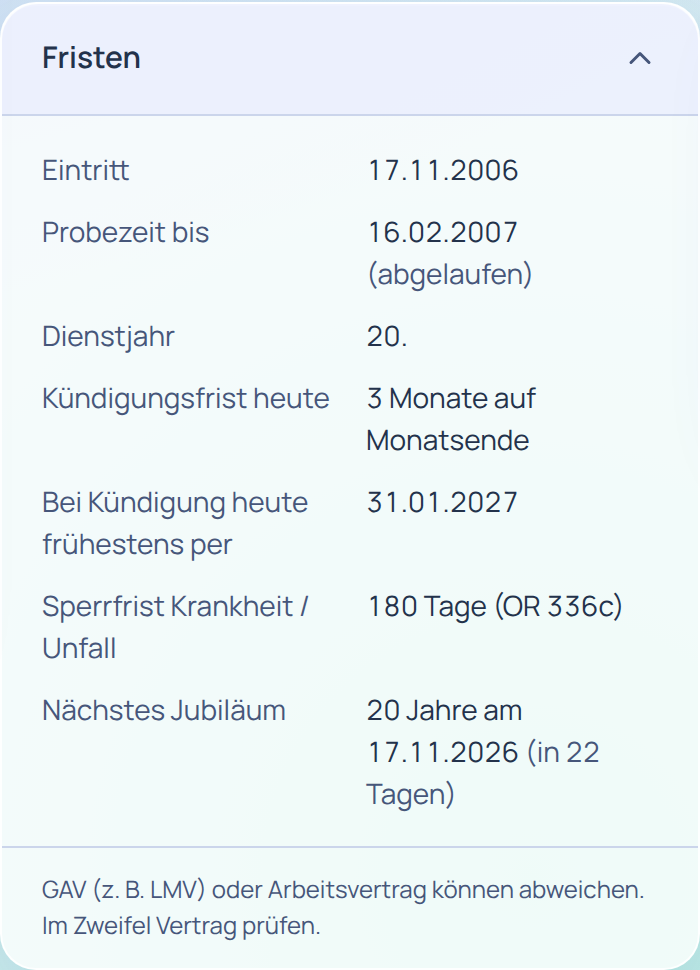
2. Earliest date. If notice is given today, earliest leaving date displays seven days during probation, otherwise month-end after notice.
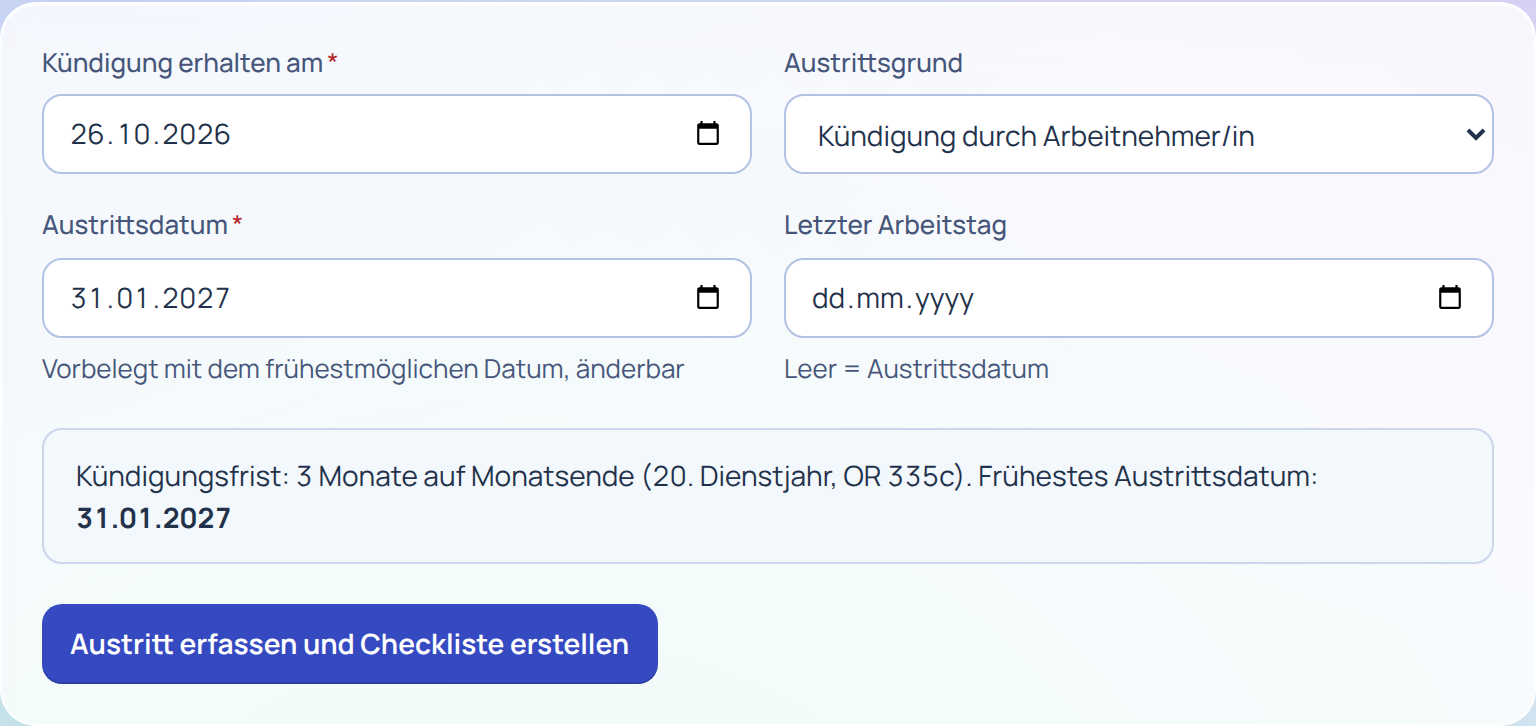
3. Record leaving. Employees › Open person › “…” › Record leaving: enter Notice received on and reason: employee/employer notice, mutual agreement or retirement. Software proposes earliest date and rule, e.g. “2 months to month-end (5th service year, CO 335c)”. Override contractual differences. Last working day is optional. Receipt defaults to today: enter actual arrival, not writing date. The leaving checklist is created automatically.
4. Protection warning. Employer notice after probation shows Art. 336c maximum 30/90/180 days by service year; files show protection and checklists include “Check protection periods”. No automatic assessment occurs: you decide illness/accident status at receipt. Software calculates neither protection extensions nor other-parent leave extensions; adjust manually.
Try the Demo or open a test account. See Termination protection and Probation. Questions? See the Contact page.
Sources
- Code of Obligations (OR, SR 220), Art. 77, 78, 329g; Art. 334, para. 1; Art. 335, paras. 1–2; Art. 335a, paras. 1–2; Art. 335b; Art. 335c, paras. 1–3; Art. 336c, paras. 1–3, as at 1 October 2026: Fedlex (German original), accessed 26.10.2026.
- SECO: termination FAQ (notice periods, decisive time, protection periods; non-binding guidance): seco.admin.ch (in German), accessed 26.10.2026.
This guide does not replace legal or tax advice. Information as at 26 October 2026.