
When hiring, create an employment contract in writing. For indefinite employment or terms exceeding one month, communicate at least key conditions in writing. The Code of Obligations (OR; CO) generally prescribes no special contractual form, but requires written information (Art. 330b) and protects employees against detrimental deviations. This guide explains contents, limits and structure.
Individual employment contracts
Under Art. 319, para. 1 CO, an individual employment contract obliges the employee to provide services to the employer for a fixed or indefinite period. In return, the employer pays a salary based on time worked or work performed. The definition also covers regular part-time employment paid by the hour, half-day or day (para. 2). A part-time arrangement therefore still falls within this employment-contract framework.
Freedom of form and written information
No special form: Art. 320, para. 1 CO requires none unless otherwise prescribed. Employment also arises where employers accept work that circumstances indicate requires payment (para. 2).
Information duty: indefinite employment or terms over one month require written information within one month of starting (Art. 330b, para. 1):
- parties’ names;
- start date;
- job title;
- salary and supplements;
- weekly working hours.
Notify changes within one month of taking effect (para. 2). The text states no consequence for omission. Where law requires contractual writing, Art. 13–14 require all obligated parties’ handwritten signatures, equivalent to qualified electronic signatures under Art. 14, para. 2bis. Whether Art. 330b requires the same form is not explicit. SMEs commonly use a contract signed by both parties: advice, not statutory requirement.
Changing probation (Art. 335b, para. 2) or notice periods (Art. 335c, para. 2) requires written agreement.
Recommended contract contents
Statutory defaults apply absent other agreement:
| Item | Statutory rule |
|---|---|
| Parties, start, role, salary/supplements, weekly hours | Minimum information, Art. 330b, para. 1 |
| Duration | Fixed/indefinite (Art. 319, para. 1). Fixed terms expire without notice; tacit continuation becomes indefinite (Art. 334, paras. 1–2) |
| Salary | Agreed/customary amount or standard/collective contract rate (Art. 322, para. 1) |
| Probation | First month, seven days’ notice; written variation up to three months (Art. 335b, paras. 1–2). See Probation |
| Notice | Year 1: one month; years 2–9: two; thereafter three, to month-end. Written variation; below one month only by collective agreement in year 1 (Art. 335c, paras. 1–2). Equal for both parties, otherwise longer applies (Art. 335a, para. 1). See Notice calculations |
| Holidays | At least four weeks per service year; five until age 20 (Art. 329a, para. 1), including two consecutive weeks (Art. 329c, para. 1) |
| Overtime | Unless compensated with time off or otherwise agreed in writing, normal pay plus at least 25% (Art. 321c, para. 3). See Overtime distinctions; generator template may differ, below |
The CO sets no individual-contract minimum salary. Collective/standard contracts may do so (Art. 322, para. 1; Art. 360a). Rules outside the CO are not covered here.
Rights contracts cannot reduce
Art. 362, para. 1 CO lists rules that agreements and standard/collective contracts cannot vary to employees’ detriment: liability (Art. 321e), minimum holidays (Art. 329a, paras. 1, 3), consecutive holidays/timing (Art. 329c), holiday pay (Art. 329d, para. 1), references (Art. 330a), among others. Check deviations against Art. 361–362.
Collective and standard employment contracts
Collective employment agreements (GAV) between employers/associations and employee associations govern conclusion, contents and termination (Art. 356, para. 1). Their provisions apply directly to participating parties; conflicting mandatory terms are void/replaced, while employee-favourable deviations remain possible (Art. 357, paras. 1–2). Standard employment contracts regulate particular employment types (Art. 359, para. 1) unless otherwise agreed (Art. 360, para. 1).
The construction sector’s national collective agreement (LMV) is among SECO’s most significant generally binding agreements (1 July 2026). Use the applicable version/minimum wages at the start date.
Practical example: Muster Haustechnik AG
Fictional Muster Haustechnik AG hires fictional Ms Anna Beispiel, born 1996, as office dispatcher. Indefinite 80 per cent employment starts Monday, 1 February 2027.
| Item | Agreement | Calculation/deadline |
|---|---|---|
| Start | 1 February 2027 | – |
| Art. 330b information | Within one month | By 1 March 2027 |
| Target hours | 41.5 weekly at 100%, one of two generator values | 41.5 × 0.8 = 33.2 at 80% |
| Probation | Three months, written | 1 February–30 April 2027, cautious calculation if agreed before starting; seven days’ notice |
| Subsequent notice | Three months to month-end, written, above year-1 statutory month | June 2027 notice ends 30 September 2027 |
| Holidays | Four weeks, aged over 20 | Art. 329a, para. 1 minimum |
Both sign before starting. This matters for three-month probation: agreeing after starting has uncertain effect (case law/practice, not statutory wording); see Probation. All five details fulfil information duties before starting. Without staff regulations, the template automatically pays additional hours 1:1 without supplement. This is a template clause, not law: Art. 321c, para. 3 requires at least 25% absent other written agreement. Amend before signing if unwanted. Include salary/social costs in cash flow planning.
LMV calculation: assumed minimum CHF 5’000 monthly at 100%, fictional. CHF 3’900 at 80% scales to CHF 3’900 ÷ 80 × 100 = CHF 4’875, below minimum. HR | base checks similarly.
Checklist
- Applicable collective/standard contract wages and notice checked
- Parties, start, role, salary/supplements and weekly hours entered (Art. 330b)
- Both sign preferably before starting, at latest one month afterwards
- Indefinite/fixed duration with end date clear
- Probation/notice variations agreed in writing
- Equal notice periods
- Statutory minimum holidays
- Later changes notified in writing within one month
How KMU | base helps
The screenshots show the German interface; KMU | base is also available in French, Italian and English.
HR | base assembles contracts from personnel-file data.
1. Open. Personnel › Contracts, page Create employment contract, or Create contract within the file. Salary-related permissions control visibility.
2. Import. Take over person from employees imports personal details subject to read rights, plus salary/workload from payroll master data or last contract. Switching people clears previous personal values; contract details remain in their file.
3. Assemble. Templates cover office, operations, construction LMV and drivers, monthly/hourly pay, management and fixed terms. Fixed structure runs from start through salary, probation/notice to signatures. Select probation 1–3 months and subsequent notice per regulations/CO or 3, 4, 6 months. Add Special agreements. Maintain addresses, expense policy and “Company without staff regulations” under HR settings › Contract header; regulation names under Regulations / BVG. The flag selects CO holiday/contract basis or staff regulations.
Fixed-clause template, not a general model:
- Only 41.5/42.5 weekly target hours.
- Fixed expense categories, e.g. construction lunch, trade fairs, management, purchasing, with built-in allowances.
- CHF 20.00 monthly workwear-cleaning contribution preselected except office; check legality/desirability of deduction.
- Private company-car clause: 0.9% purchase price monthly; optional holiday blackout April/May and September–December.
- CO contracts without staff regulations pay extra hours 1:1 without supplement: product clause, not law.
- Expense regulations, job description, “Safe at work” brochure and employee privacy information always form contract parts.
Read the full preview and obtain legal review before use. Word exports are editable.
4. Preview/checklist. Live preview sits beside the form. Still to check flags missing name, start, role, salary, regulations, LMV class, fixed-term date absent/before start and below-minimum LMV pay. Missing essentials appear as visible gaps. PDF export asks about missing workload, hours, probation or signature location; Word exports without asking. This checks completeness, not clause legality.
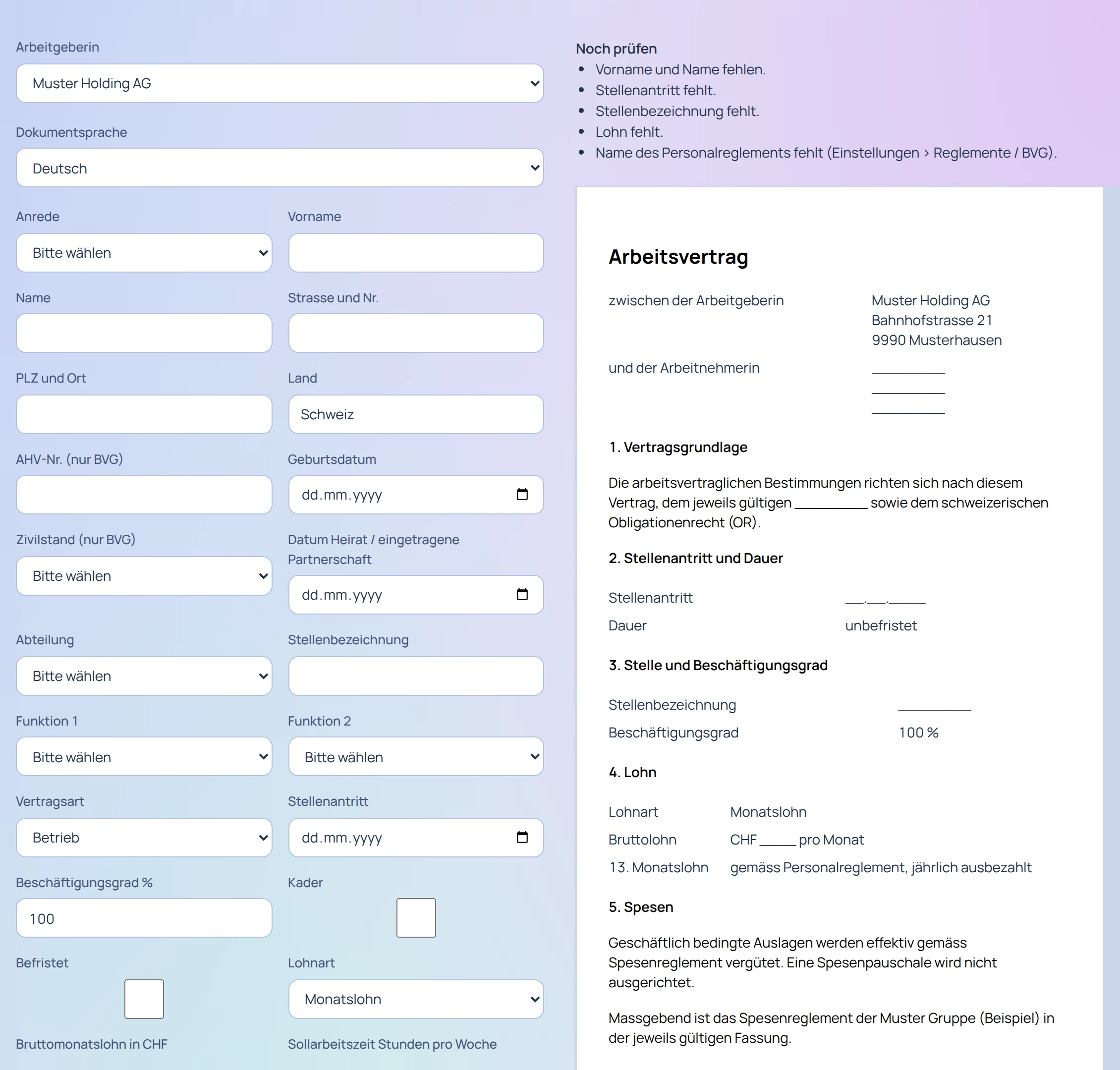
5. Languages. Generate DE/FR/IT/EN in the person’s language, changeable during generation. English says it is a translation and the workplace official-language version prevails in disputes. This clause is legally unreviewed; obtain review before using foreign-language versions.
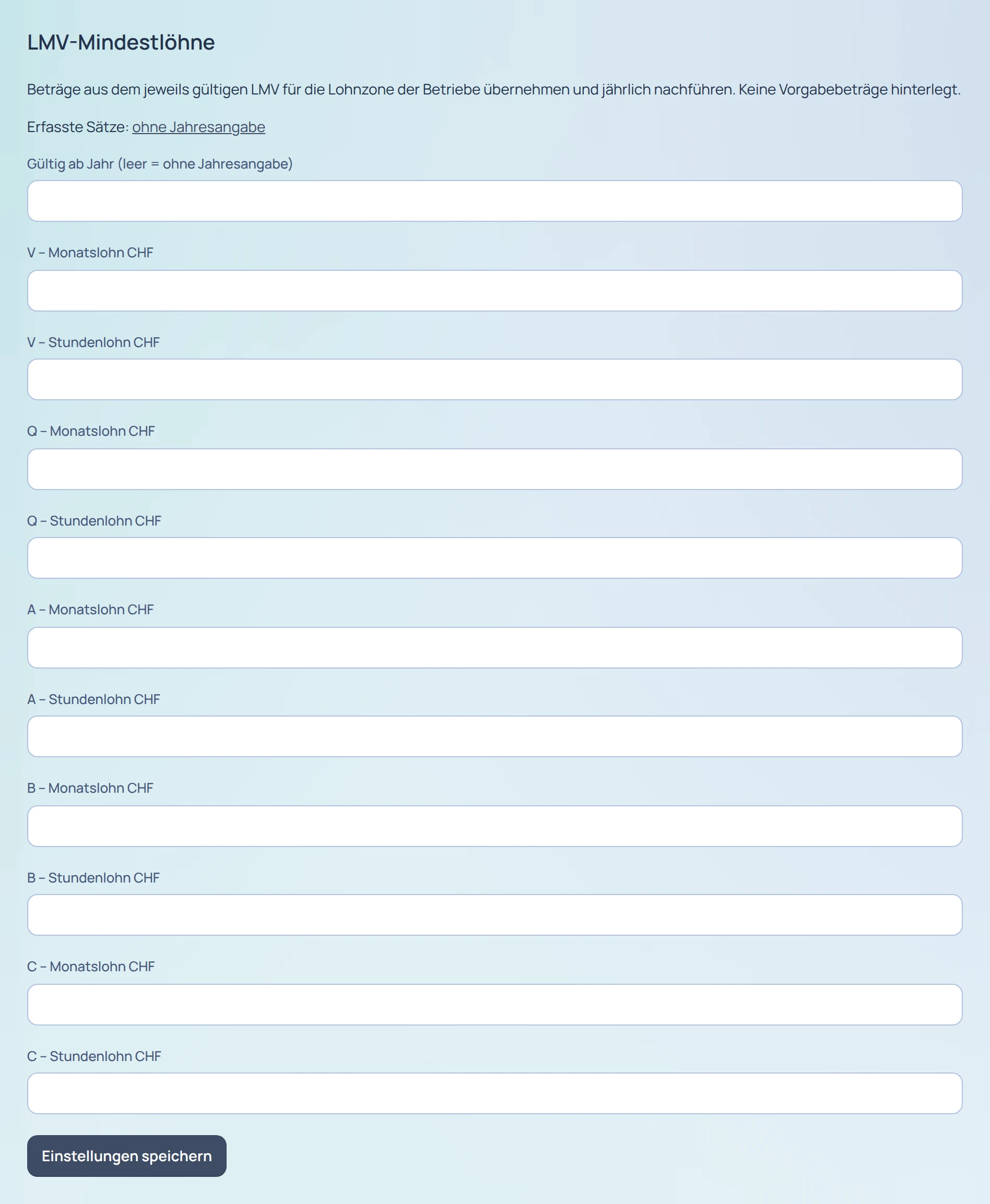
6. LMV wages. HR settings › Staff and contracts › LMV minimum wages: enter monthly/hourly amounts per class and effective year. HR supplies no amounts; copy applicable LMV values. Checks use the latest effective year up to start year.
7. Export/file. Download PDF/Word; exports are logged. PDFs created for personnel-file people are filed under Contracts.
Try the Demo or open a test account. Questions? See the Contact page.
Sources
- Code of Obligations (OR, SR 220), Art. 12–14, 319, 320, 321a, 321c, 322, 329a, 329c, 329d, 330a, 330b, 334, 335a–335c, 356, 357, 359, 360, 361 and 362, as at 1 October 2026: Fedlex (German original), accessed 26.10.2026.
- SECO: Collective employment agreements declared generally binding (in German), statistics as at 1 July 2026, accessed 26.10.2026 (LMV among the most significant generally binding agreements).
Signature recommendations, deadline calculations and worked examples are our explanations using fictional values.
This guide does not replace legal or tax advice. Information as at 26 October 2026.