
The probation period lets both parties get acquainted and end employment quickly. Errors usually concern dates: exact expiry, latest receipt of notice and illness extensions. This guide explains Art. 335b of the Code of Obligations (OR; CO), Supreme Court decisions where legislation is silent, and a dated example.
Duration
Art. 335b, paras. 1–2 CO sets the starting rule and the ways in which it can be changed:
- Unless another valid arrangement applies, the first month of employment is the probation period.
- The parties may agree a different duration in writing. A standard employment contract or collective employment agreement may also provide a different rule. In each case, probation may last no more than three months.
SECO says longer agreements still mean only three months; duration must match for both parties. Agreements may shorten/remove probation (SECO, BDO). Fixed-term employment has no statutory probation, but parties may agree one. Part-time work does not extend it (BGE 136 III 562, consideration 3).
| Situation | Probation |
|---|---|
| No written agreement | First month |
| Written, standard or collective contract | As agreed, maximum three months |
| More than three months agreed | Still three (SECO; BGE 136 III 562, consideration 3) |
An oral agreement for three months of probation is therefore problematic. Put the agreed duration in the employment contract, rather than relying on a spoken understanding between the parties.
Calculate probation expiry
Law does not further define “first month”. BGE 144 III 152, consideration 4.4, applies Art. 77, para. 1, point 3 CO. Probation starts on actual joining. If the contract is concluded that day, exclude it because it is not fully available. Expiry is the corresponding numbered day in the final month:
- Start 15 July 2015, one month: 15 August 2015 (BGE 144 III 152).
- Start 16 March 2020, three months: 16 June 2020 (8C_317/2021, consideration 5.2.3.1).
- Missing corresponding date, e.g. 31 January plus one month: final day, 28 February 2027.
The Court left earlier contract conclusion unresolved (BGE 144 III 152, consideration 4.4.3), although commonly signed beforehand. Cautiously plan the earlier day: 15 January plus one month = 14, not 15 February. This is cautious planning, not settled law. Art. 78 applicability to Sunday/public-holiday expiry also remains open (8C_317/2021, consideration 5.2.9). Do not assume extension. Record signature and probation-end dates.
Notice during probation
Art. 335b, para. 1 CO and SECO provide:
- Seven calendar days, not working days.
- Any time: no month/week-end restriction unless agreed.
- Receipt during probation: notice must arrive before expiry; its seven days may extend beyond (SECO, BDO).
- Form: oral suffices unless contract/collective agreement requires writing. SECO recommends written registered notice as evidence. Recipients may demand written reasons (Art. 335, para. 2).
- Variations: written agreement, standard/collective contract may shorten, extend or remove notice.
Illness, accident, pregnancy and service protection applies only after probation (Art. 336c, para. 1); employers can dismiss ill employees during probation (SECO, BDO). Still, dismissal may be abusive: BGE 134 III 108, consideration 7.1, assesses cases against probation’s purpose. References may be requested anytime (Art. 330a); see Reference letters.
For the seven-day notice period, Art. 77, para. 1, point 1 together with para. 2 excludes the day on which notice is received. Count the following day as day one; the period ends on day seven. Notice received on Wednesday, 2 June 2027 therefore ends employment on Wednesday, 9 June 2027.
Illness, accident and compulsory-duty extensions
If illness, an accident or an involuntary statutory duty actually reduces the probation period, Art. 335b, para. 3 CO extends it by the corresponding amount. The statutory list is exhaustive. Unpaid leave does not trigger this extension (BGE 136 III 562, consideration 3). The Court also refers to broad agreement in legal scholarship concerning holidays. According to SECO, an extension resulting from illness can take probation beyond the usual maximum of three months.
8C_317/2021, 8 March 2022, considerations 5.2.6–5.2.7, counts whole working days actually missed, not calendar days, even for short absences. Illness on non-working Sundays does not count; missed working days must actually be made up. It concerned public-law SBB employment with supplementary CO application. This guide knows no identical private-employment ruling, but it offers a sound planning basis.
Extension by agreement
Legislation does not expressly address longer probation agreed after starting. BDO says exceeding three months is generally impermissible; within three months, contractual extensions, e.g. for holidays, are possible. Agree in writing before current probation expires. This is practice, not statutory text; seek legal advice in disputes.
Review and decision
Probation reviews are not required by statute, but they help both sides prepare a decision. Do not plan the review so late that there is no time left to deliver notice with proof of receipt after the decision has been made. If notice arrives too late, the ordinary notice periods apply; see Calculate notice periods.
Practical example: Gärtnerei Berger AG
Fictional Gärtnerei Berger AG hires Nadia Frei as project manager Wednesday, 3 March 2027. Both sign that day: three-month probation, default seven-day notice. BGE 144 III 152 therefore applies.
| Step | Date | Explanation |
|---|---|---|
| Start/signature | Wed 3.3.2027 | Probation begins; exclude this day |
| Unextended end | Thu 3.6.2027 | Three months, corresponding number |
| Illness | Mon 15.3.–Wed 17.3.2027 | Three missed working days, medical certificate |
| Make-up days | Fri 4.6., Mon 7.6., Tue 8.6.2027 | Three working days after 3.6.; five-day week, no holidays assumed |
| Extended end | Tue 8.6.2027 | Final probation day |
Monday, 7 June: management decides the relationship is unsuitable. Without illness, probation ended four days earlier; extended, it continues through 8 June. Personal delivery Monday with signed receipt gives seven days to Monday, 14 June 2027.
Overlooking the extension and using first-service-year rules would mean one month to month-end: 31 July 2027, 47 days later (14 June–31 July).
Had signature been in February, cautious unextended expiry would be 2 June, extended Monday, 7 June 2027.
Checklist
- Written probation, maximum three months
- Signature and expiry dates expressly recorded
- Earlier signature: cautiously use earlier expiry
- Any different notice agreed in writing
- Illness/accident/duty absences recorded; whole working days recalculated
- Review scheduled before expiry
- Provable notice receipt before expiry
- Reference and leaving process planned
How KMU | base helps
The screenshots show the German interface; KMU | base is also available in French, Italian and English.
HR | base shows expiry in personnel files and reminds through review checklists. Check legal dates yourself: its fixed rules differ in two respects.
1. Enter. Personnel › Employees › Record new joiner, “Probation”: 1, 2 or 3 months. Default three; LMV departments two. No more than three, less than one or none. Match written agreement; statutory default without agreement is one month.
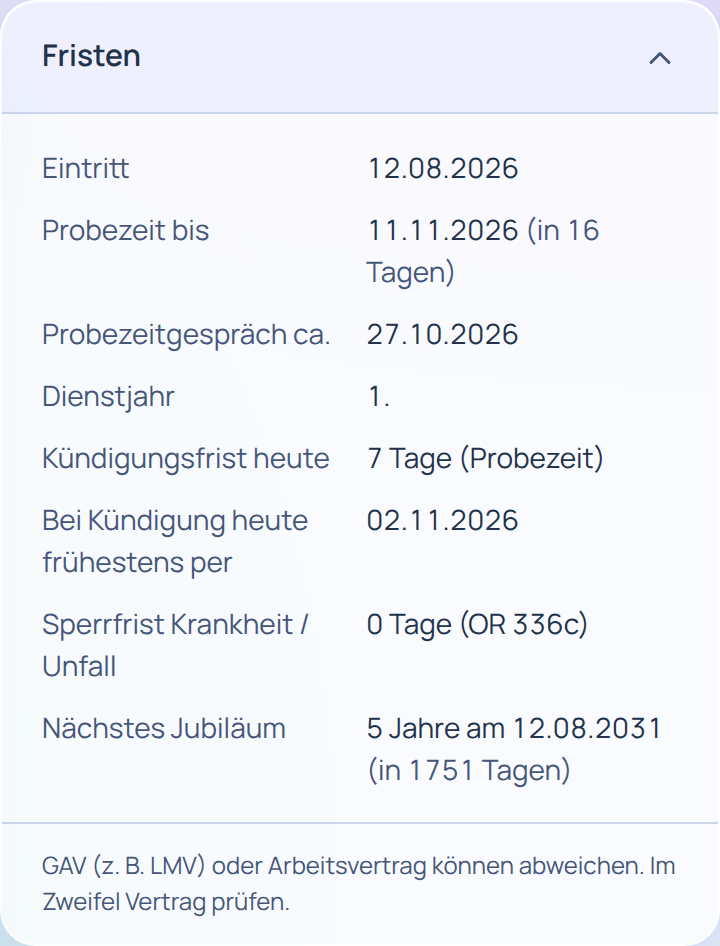
2. Expiry. “Probation until” calculates joining plus months minus one day: 2 June 2027 above. That suits cautious earlier-signature planning but is one day early for same-day conclusion under BGE 144 III 152.
3. Extensions. Approved illness, accident and military absences extend automatically; enter/approve under Absences. Software adds calendar days, while the Court requires whole working days made up. It may be:
- Early: 2 June + three calendar days = Saturday, 5 June, versus legal Tuesday, 8 June. Monday, 7 June notice would appear outside probation.
- Late: absences spanning weekends/part-time days off add days not legally counted (8C_317/2021, consideration 5.2.6).
Legal dates govern, not displays. Recalculate illness/accident/service extensions yourself.
4. Review. Automatically calculated review dates shift with extensions and drive checklist due dates/manager emails.
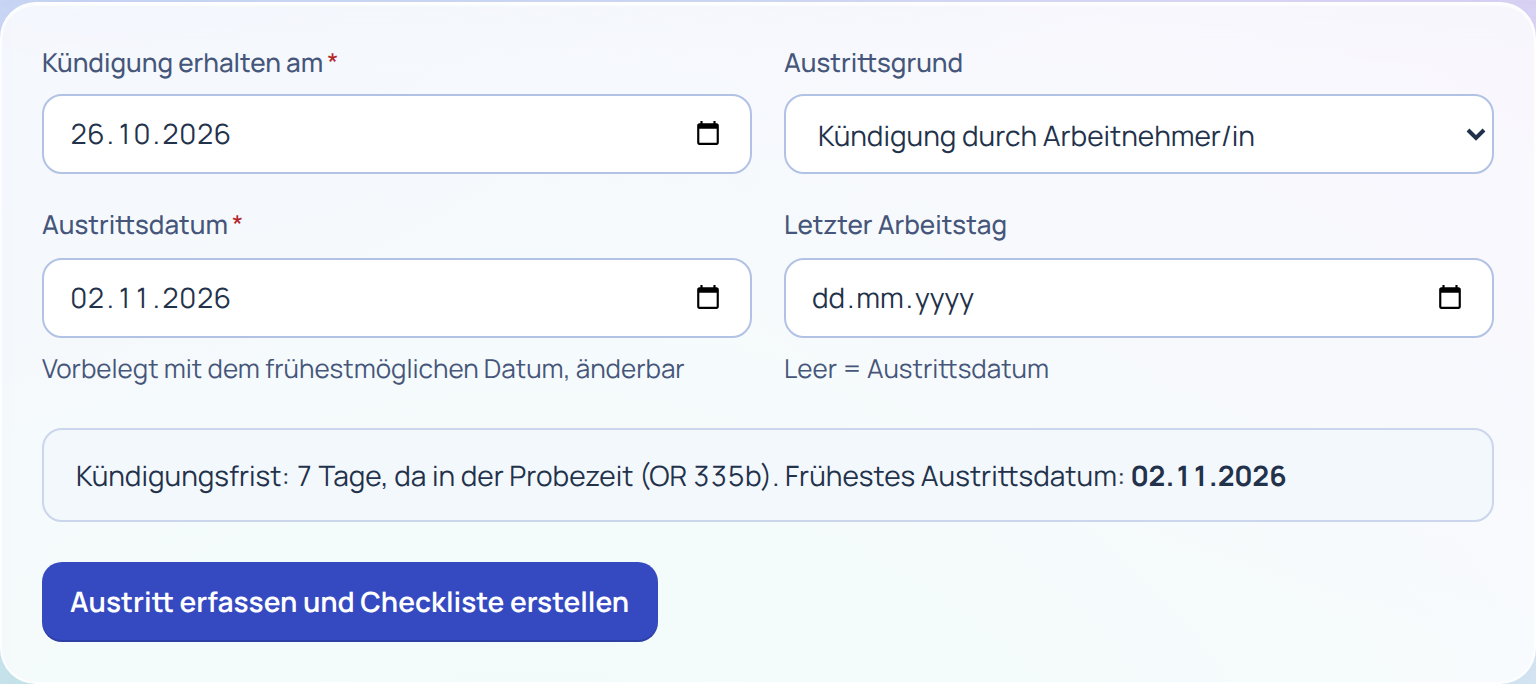
5. Notice. Employees › Open person › “…” › Record leaving: enter actual receipt. If displayed within probation, seven days and earliest leaving date appear; otherwise service-year rules, e.g. 7 June gives 31 July instead of 14 June. Override for contractual rules/display discrepancies. Software counts seven calendar days (LMV five working days) without shifting to a working day.
Try the Demo or open a test account. See Notice periods and Termination protection. Questions? See the Contact page.
Sources
- Code of Obligations (OR, SR 220), Art. 77, paras. 1–2; Art. 78; Art. 330a; Art. 335, para. 2; Art. 335b, paras. 1–3; Art. 336; Art. 336c, para. 1, as at 1 October 2026: Fedlex (German original), accessed 26.10.2026.
- Federal Supreme Court, BGE 144 III 152 (4A_3/2017, 15 February 2018), consideration 4: bger.ch (in German), accessed 26.10.2026.
- Federal Supreme Court, BGE 136 III 562 (4A_406/2010, 14 October 2010), consideration 3: bger.ch (in German), accessed 26.10.2026.
- Federal Supreme Court, BGE 134 III 108 (4A_385/2007, 28 November 2007), consideration 7.1: bger.ch (in German), accessed 26.10.2026.
- Federal Supreme Court, 8C_317/2021, 8 March 2022 (public employment law, SBB), considerations 5.2.3–5.2.9: bger.ch (in German), accessed 26.10.2026.
- SECO: termination FAQ (probation, duration, form, timing; non-binding guidance): seco.admin.ch (in German), accessed 26.10.2026.
- BDO: Probation – answers to the ten most important questions, 10.05.2022, specialist article: bdo.ch (in German), accessed 26.10.2026.
This guide does not replace legal or tax advice. Information as at 26 October 2026.