
A profitable business can still struggle to pay month-end salaries: receipts arrive after payments leave. Cash flow planning asks how much money will be in the account over coming weeks. This guide explains an SME forecast, its payments, Swiss duties and supporting budgets/metrics.
Profit is not liquidity
Profit arises when accounting income exceeds expenses; liquidity is actually available money. Weeks may separate them: October invoicing, December customer payment, November supplier deadline. A financial manager interviewed by PostFinance identifies this timing gap as the commonest error: profitable companies can face cash crises.
SECO’s SME portal notes irregular annual costs/receipts. Planning identifies when funds are needed. Suggested responses include prompt invoicing, shorter terms, deposits/payments on account and credit facilities.
Forecast contents
A time-based table has four parts:
| Part | Meaning |
|---|---|
| Opening balance | Bank/cash at start |
| Inflows | Expected receipts |
| Outflows | Planned payments |
| Balance | Opening plus inflows minus outflows, carried week to week |
Two practical principles determine how to use this table. First, enter a receipt or payment in the period when the money is expected to move, rather than the period containing the invoice date. An invoice issued on 12 May and due on 11 June therefore belongs in June in the cash-flow forecast. Second, keep the forecast rolling. Each week, remove the week that has elapsed and add another week at the far end, so the planning horizon stays the same length. The financial manager interviewed in the PostFinance article recommends an honest weekly look at the figures and suggests a buffer of at least three months’ expenses. These are practical recommendations, rather than statutory requirements.
Record inflows and outflows
Inflows usually include:
- open customer invoices by due date; assess/chase overdue ones first, see Payment reminders;
- recurring/subscription invoices;
- expected deposits/other receipts.
Outflows usually include:
- salaries/social contributions;
- rent, leasing, insurance;
- supplier invoices;
- FTA VAT payments, see Swiss VAT returns;
- taxes, interest and investment.
Do not forget one-off/annual payments: premiums, tax bills, replacement investments. Enter dates/amounts when known. See Accounts receivable and open items.
Legal duties: solvency and capital loss
Art. 725, para. 1 of the Code of Obligations (OR; CO) expressly requires AG boards to monitor solvency. If insolvency threatens, take solvency measures, other necessary restructuring action or propose it to shareholders, and seek a debt-restructuring moratorium where necessary (para. 2), with due urgency (para. 3). Art. 820 applies correspondingly to GmbHs.
The law does not prescribe a particular tool for monitoring solvency. In our assessment, a regularly updated forecast is a practical way to make that monitoring traceable. This is our recommendation for carrying out the task, rather than a statutory requirement to use a cash-flow table.
Distinguish capital loss under Art. 725a, para. 1. Latest annual assets less liabilities no longer cover half the sum of share capital, statutory capital reserves not repayable to shareholders and statutory retained earnings. The board must remedy it. Fictional example: CHF 100’000 capital + CHF 20’000 statutory retained earnings, no relevant capital reserve = CHF 120’000; half CHF 60’000. Assets CHF 410’000 less liabilities CHF 365’000 = CHF 45’000, below CHF 60’000: capital loss. Forecasts look forward at payments; capital loss looks back at the balance sheet. Neither replaces the other.
Reasonable concern that liabilities exceed assets requires immediate interim statements (Art. 725b, para. 1). Involve fiduciaries/auditors.
Budget versus actual
A cash-flow forecast shows when payments are expected. A budget instead sets out the revenue and costs expected in each month of the year. Comparing the budget with actual figures shows how the business is progressing. Keep these views distinct: budget comparisons usually follow invoice dates, whereas the cash-flow forecast follows payment dates. Revenue in December may therefore exceed the budget even though the money will not arrive until January.
The same blog says rolling plans become management tools when compared with actuals and major differences analysed.
Early-warning metrics
Four sales indicators:
- Revenue versus prior-year month: growth/contraction.
- Open/overdue receivables: unpaid invoices and overdue portion.
- DSO, Days Sales Outstanding: days of revenue outstanding. Simple formula: open receivables ÷ last 90 days’ revenue × 90. CHF 45’000 / CHF 150’000 × 90 = 27 days.
- Average payment time: invoice-to-payment days. Thirty-day terms but 45-day average require cautious planning.
Quotation success rate is a useful fifth indicator of forthcoming order volume.
Practical example: Muster Metallbau GmbH
Fictional Muster Metallbau GmbH has four employees. Monday, 2 November 2026: bank CHF 12’000; six-week horizon. Six open invoices plus monthly CHF 1’900 maintenance subscription (excluding VAT, as recurring forecasts calculate), next issued 2 November, received 2 December after 30 days. Six outgoing payments follow.
| Week from | Inflows | Outflows | Week-end balance |
|---|---|---|---|
| 2.11. | 10’700 (6’500 overdue; 4’200 due 5.11.) | 0 | 22’700 |
| 9.11. | 12’800 (due 13.11.) | 8’900 (supplier, 12.11.) | 26’600 |
| 16.11. | 0 | 2’400 (insurance, 17.11.) | 24’200 |
| 23.11. | 9’600 (due 27.11.) | 23’250 (salaries 18’500 on 25.11.; VAT 4’750 on 27.11.) | 10’550 |
| 30.11. | 9’200 (subscription 1’900 on 2.12.; invoice 7’300 due 4.12.) | 9’400 (rent 3’200 on 1.12.; supplier 6’200 on 3.12.) | 10’350 |
| 7.12. | 5’400 (due 11.12.) | 0 | 15’750 |
All positive, lowest CHF 10’350 in week 30 November. Stress-test: CHF 12’800 arrives week 7 December rather than 13 November. Manual recalculation gives minus CHF 2’250 after salary week (23 November), minus CHF 2’450 next week, then CHF 15’750 when CHF 12’800 arrives. Planning leaves time to remind the customer, discuss bank credit or reschedule a supplier payment.
Annual revenue budget CHF 480’000, evenly CHF 40’000 monthly. October invoices CHF 36’000: minus CHF 4’000, minus 10.0 per cent. Prior October CHF 40’000: also minus 10.0 per cent. These describe sales; weekly forecasts describe cash.
Checklist
- Current bank opening balance entered
- Rolling horizon selected, at least several weeks
- Customer invoices by due date; overdue separately assessed
- Recurring invoices included
- Recurring salaries, contributions, rent/insurance entered
- Suppliers, VAT and taxes dated
- One-off investments/annual premiums entered
- Largest invoice delayed four weeks in scenario
- Weekly updating scheduled
- Buffer defined; bank approached before shortages
- Budget compared with actual; differences explained
How KMU | base helps
The screenshots show the German interface; KMU | base is also available in French, Italian and English.
Under Goods and projects, open Budget and cash flow. Metrics sit above Budget/Cash flow tabs.
1. Forecast. Enter today’s bank balance and 4–52 weeks (default 13), then Calculate. Monday-based rows show inflow/outflow/balance. “n items” explains sources: open invoices by due date (overdue in week one), active recurring schedules with 30-day terms and own planned payments. Negative balances trigger a warning with the lowest value.
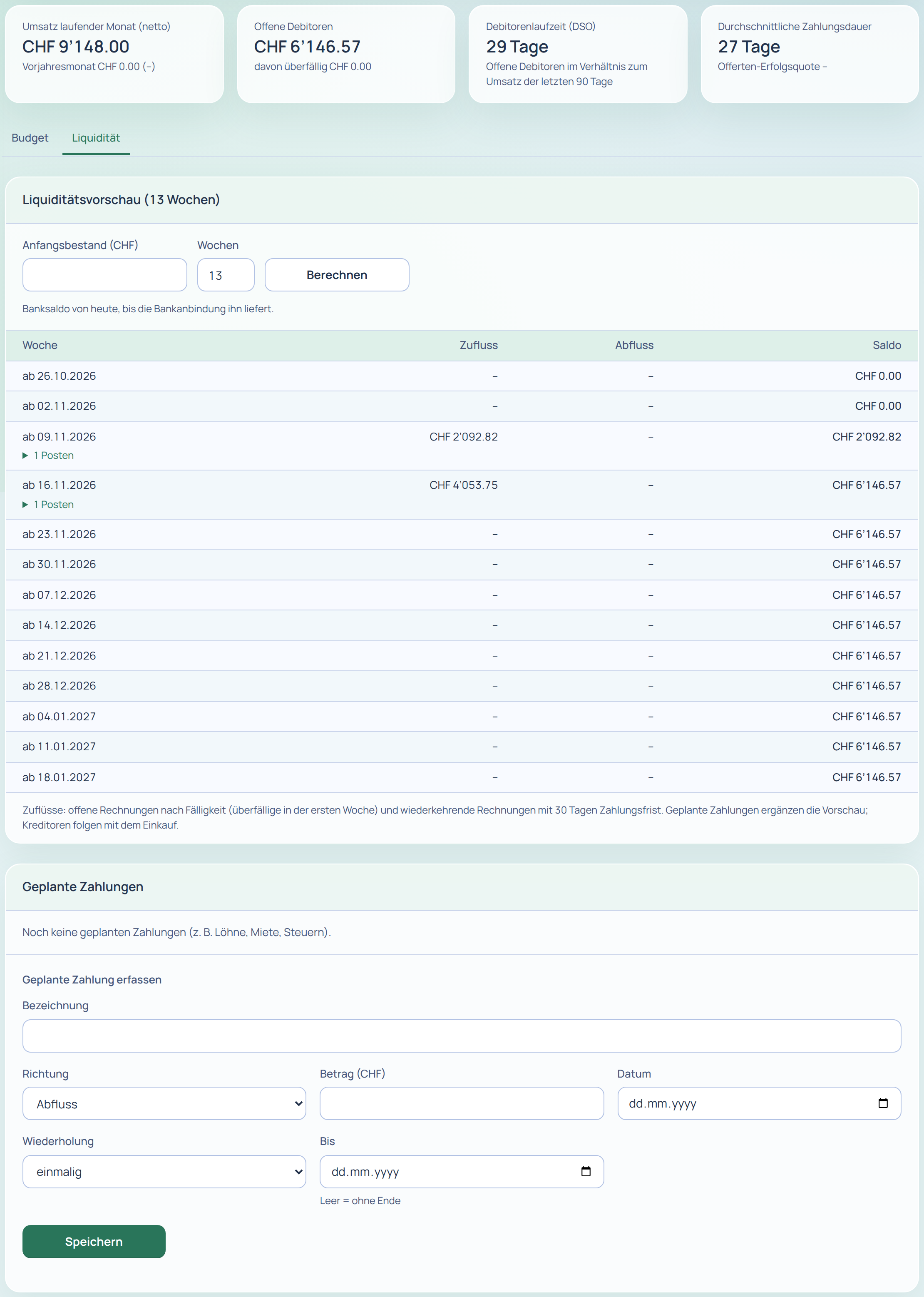
2. Planned payments. Enter salaries, rent, taxes, VAT and others with description, inflow/outflow direction, amount, date and recurrence: once, monthly, quarterly or annually, optional end date.
Limits:
- Purchasing supplier invoices are not included automatically; enter planned payments.
- Opening balance is manual.
- Recurring amounts sum quantities × prices less discounts, without VAT.
- Open invoices use due dates; no late-payment assumption. Overdue enters week one. Model delays manually as above.
- EUR/USD amounts are counted as francs, without conversion.
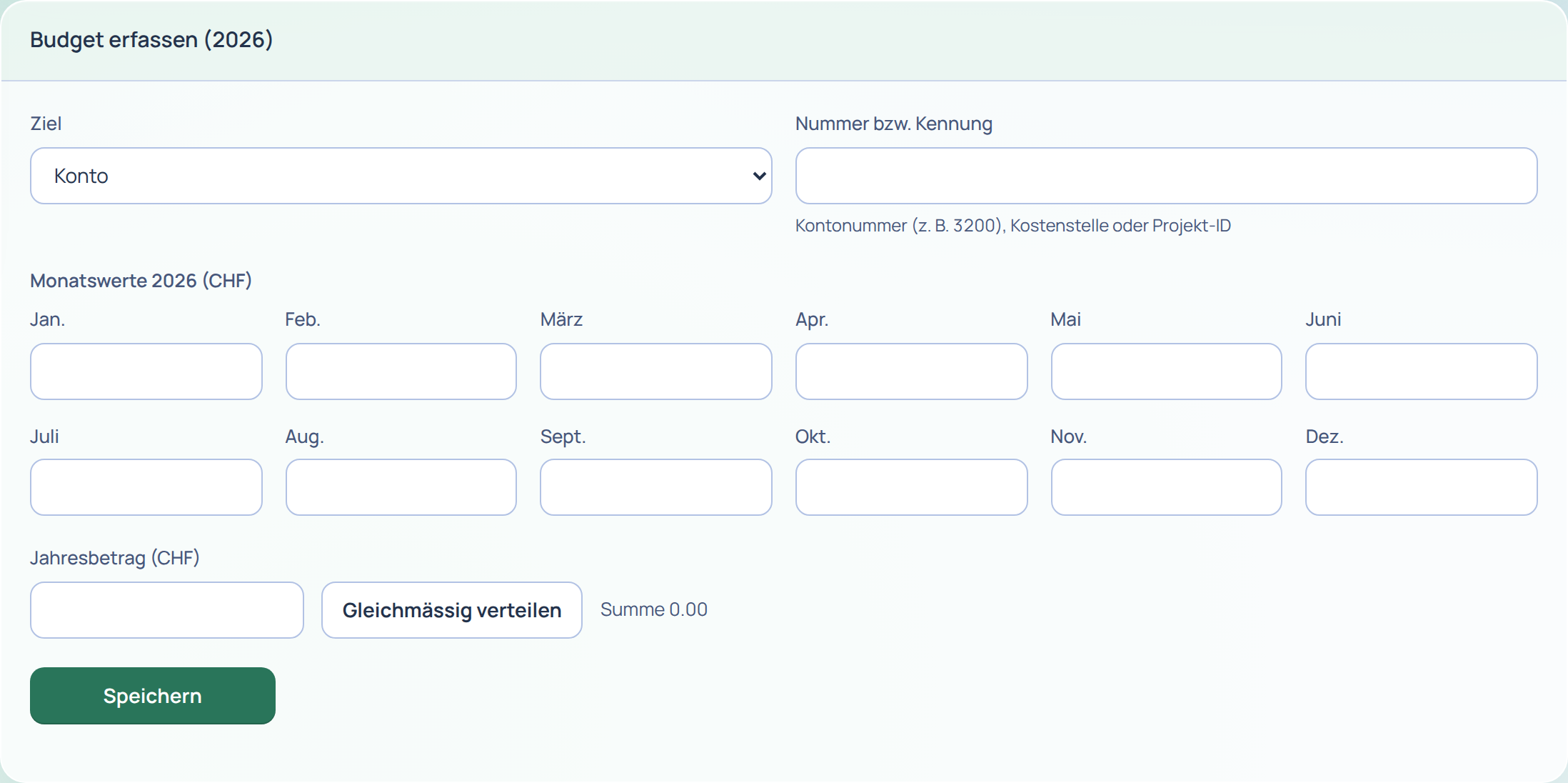
3. Budget. Plan by account, centre or project/month. Enter twelve values or annual amount with Spread evenly. Comparison shows budget, actual and variance monthly. Account actuals use issued invoice revenue less credits by item revenue account (without item: 3200). Project actuals use billed project time by billing date, already from draft invoice. Centres have no actuals yet: “Actual only with accounting”. Expense-account budgets show “Actual 0”, red minus 100 per cent because actuals derive only from revenue. Thus currently mainly a revenue budget; cost budgets cannot be compared with actual costs here.
4. Sales metrics. Four tiles show current net monthly revenue versus last year, open/overdue receivables, DSO, average payment time and quotation success rate. Foreign-currency invoices are excluded from revenue/receivables.
Users with sales read access can view the page; only users with permission to manage sales can enter budgets and planned payments.
Try the Demo or open a test account. Questions? See the Contact page.
Sources
- Code of Obligations (OR, SR 220), Art. 725, paras. 1–3; Art. 725a, para. 1; Art. 725b, para. 1; Art. 820, as at 1 October 2026: Fedlex (German original), accessed 26.10.2026.
- PostFinance Business Blog, interview with an external financial manager: Full order book, empty account? Why SME liquidity is a management responsibility (in German), published 30.07.2026, accessed 26.10.2026 (practical advice, not law).
- SECO SME portal: Stay solvent through cash flow planning (in German), accessed 26.10.2026 (practical advice, not law).
DSO, weekly-balance and budget-variance calculations are our explanations using fictional figures, not authority requirements.
This guide does not replace legal or tax advice. Information as at 26 October 2026.