
Selling on invoice creates many receivables: money arrives later, sometimes late or only partly. Accounts receivable records who owes what and since when. This guide covers open items, payment allocation, ageing analysis and limitation periods under the Code of Obligations (OR; CO).
What accounts receivable does
Debtors are customers owing you money. The balance sheet shows “Trade receivables”, usually account 1100; see SME chart of accounts. The general ledger shows the total; the subsidiary ledger shows each invoice as an open item with customer, invoice/due dates, amount and balance. Open items must total the control-account balance.
The Ordinance on Accounting Records (GeBüV) expressly mentions receivables. Businesses subject to bookkeeping must keep a general ledger and, depending on type/size, subsidiary ledgers (Art. 1, para. 1). These must establish financial position and business liabilities/receivables, particularly customer and supplier accounts (para. 3). Art. 957a, para. 2 CO requires complete, truthful, systematic recording, supporting evidence and verifiability. Retain books and supporting records for ten years from financial year-end (Art. 958f, para. 1).
Day to day: who has not paid, for how long, and how much money is tied up?
Maintain open items
An item arises on invoicing and closes when its balance reaches zero. Statuses are open, partly paid and paid. Credit notes and cancellations also reduce it. Follow these rules:
- One invoice, one item: never combine invoices into a lump sum; payments/reminders need individual allocation.
- Record due dates: age runs from due date, not invoice date, as stated in the invoice or customer agreement.
- One source: enter invoices in sales or manually in the subsidiary ledger, never both.
Allocate payments
Most payments match a QR-reference and amount. Batch payments, part payments and missing references are harder. For several debts to one creditor, the CO provides:
- Debtors may specify which debt a payment settles (Art. 86, para. 1). Otherwise the creditor’s receipt determines allocation unless immediately disputed (para. 2).
- Without valid designation or receipt allocation, apply to a due debt; among several, first to that subjected to debt enforcement earliest, otherwise the earliest due (Art. 87, para. 1).
- Part payments reduce principal only insofar as interest/costs are not overdue (Art. 85, para. 1).
Use references and ask customers about ambiguities. For bank-file allocation, see Bank reconciliation with camt files.
Read the ageing analysis
Ageing groups open items by time since due date. Common bands:
| Band | Meaning |
|---|---|
| Not due | Payment term still running; normal |
| 1–30 days | Often oversight or customer payment cycle |
| 31–60 days | Reminder due; contact customer |
| 61–90 days | Clarify disputes or payment difficulties |
| Over 90 days | Escalate: reminders, debt enforcement, valuation |
These bands are convention, not law. Read beyond totals: a few large oldest items differ from many small newer ones.
The last band matters for closing. Material assets generally require individual valuation unless normally grouped by similarity (Art. 960, para. 1 CO). Concrete signs of overvaluation require review and, where necessary, adjustment (para. 3). A silent customer with a debt over 90 days old may indicate this. Discuss whether/how much to impair with your fiduciary; this guide does not address the tax treatment.
Customer statements
A statement lists a customer’s invoices/payments for a period, with opening and running balances. If customers say they paid, both parties can inspect the same list. Send it before a second reminder. It reveals misallocated payments, unused credit notes and duplicate invoices early.
Due dates, default and limitation
Contracts or invoices set due dates; without agreement, performance may be demanded immediately (Art. 75 CO). Default follows a reminder or expiry of an agreed fixed date (Art. 102); see Write a payment reminder for interest and stages.
Receivables do not remain enforceable forever:
- Generally ten years, unless federal civil law provides otherwise (Art. 127).
- Five years applies, among others, to craft work, retail goods, medical services, professional work by lawyers, legal agents, procurators and notaries, and employment claims (Art. 128, point 3). Rent, lease payments, interest and other periodic payments also have five years (point 1).
- Time runs from when the claim falls due (Art. 130, para. 1). Exclude the starting day; limitation completes only when the final day passes unused (Art. 132, para. 1).
- Parties cannot alter these periods (Art. 129). Interest becomes time-barred with the principal claim (Art. 133).
- Interruption includes debtor acknowledgement, notably interest/part payments, debt enforcement, conciliation requests or litigation (Art. 135). Time restarts (Art. 137, para. 1); each debt-enforcement act restarts it (Art. 138, para. 2). Art. 135 does not list a mere reminder.
- Courts cannot consider limitation of their own motion (Art. 142). Monitor it nevertheless.
The applicable period depends on Art. 128 classification. Services and goods sold to business customers are not automatically craft work or retail. If unsure, cautiously use the shorter period and obtain specialist advice.
Reconcile before closing
Open items must equal the “Trade receivables” control account. Differences commonly arise from direct control-account postings bypassing the subsidiary ledger or unallocated payments. See Year-end checklist.
Practical example: Muster Elektro AG
Fictional Muster Elektro AG reviews receivables on Wednesday, 30 September 2026. Six invoices from four customers remain open, with 30-day terms.
| Customer | Invoice | Amount (CHF) | Due | Days overdue | Band |
|---|---|---|---|---|---|
| Gemeinde Musterwil | 0415 | 8’640.00 | 15.10.2026 | Not due | Not due |
| Bäckerei Muster AG | 0398 | 2’350.00 | 12.09.2026 | 18 | 1–30 days |
| Bäckerei Muster AG | 0377 | 1’180.00 | 20.08.2026 | 41 | 31–60 days |
| Hotel Muster GmbH | 0341 | 4’900.00 | 02.07.2026 | 90 | 61–90 days |
| Schreinerei Muster | 0302 | 3’270.00 | 28.05.2026 | 125 | Over 90 days |
| Schreinerei Muster | 0412 | 1’560.00 | 25.09.2026 | 5 | 1–30 days |
Ageing by band (total row is a subtotal):
| Band | Amount (CHF) |
|---|---|
| Not due | 8’640.00 |
| 1–30 days (2’350.00 + 1’560.00) | 3’910.00 |
| 31–60 days | 1’180.00 |
| 61–90 days | 4’900.00 |
| Over 90 days | 3’270.00 |
| Total open items | 21’900.00 |
Overdue: 13’260.00 (21’900.00 − 8’640.00), around 61 per cent. Invoice 0341 is exactly 90 days overdue, still in 61–90. Customer totals: Gemeinde 8’640.00, Bäckerei 3’530.00, Hotel 4’900.00, Schreinerei 4’830.00; total 21’900.00.
Bäckerei Muster AG’s statement for 1 July–30 September 2026 explains its balance:
| Date | Transaction | Amount (CHF) | Balance (CHF) |
|---|---|---|---|
| 01.07.2026 | Opening balance (invoice 0361) | 960.00 | |
| 21.07.2026 | Invoice 0377 | +1’180.00 | 2’140.00 |
| 04.08.2026 | Payment, invoice 0361 | −960.00 | 1’180.00 |
| 13.08.2026 | Invoice 0398 | +2’350.00 | 3’530.00 |
Closing balance 3’530.00 matches its two open items. Muster Elektro AG calls the bakery and sends the statement before chasing 0377. Management receives carpenter invoice 0302, over 90 days, for valuation and an enforcement decision. Cautiously applying five years, its claim due 28 May 2026 becomes time-barred at end-28 May 2031 unless interrupted.
Checklist
- Each invoice has its own open item, due date and supporting record
- References allocate payments; uncertainties clarified with customer
- Ageing reviewed regularly, at least monthly
- Overdue customers contacted/reminded; agreements recorded
- Statement sent before second reminder or for queries
- Over-90-day items valued and discussed with fiduciary
- Limitation monitored; interruption considered
- Open-item total matches control account
- Books and records retained ten years
How KMU | base helps
The screenshots show the German interface; KMU | base is also available in French, Italian and English.
Finance | base manages customers and suppliers in subsidiary ledgers.
1. Customers. Under Accounting, open Customers and suppliers. Switch between Suppliers (payables) and Customers (receivables); suppliers open first. Create partner at the bottom records address, UID, IBAN, email and payment term per company.
2. Invoices. Issued sales invoices, credit notes and payments, including partial payments, automatically reach the journal and receivables ledger exactly once per document. This requires accounting configured for the company. Record invoice also manually posts customer/supplier invoices with account, VAT code, cost centre and due date, creating open items.
3. Open items. Lists by type show due date (overdue red), amount, balance and “Payment prepared” status.
4. Payments. Record sales payments manually on the document (partial payments leave a balance) or import bank files under Sales › Incoming payments. Credits match QR/RF-references; neither files nor bank entries import twice. For manually posted subsidiary-ledger items, Post payment settles selected items via a bank account, always the full balance. Partial payments are unavailable there; record them on sales invoices. For supplier payment runs, importing camt.053/054 recognises EndToEndId, posts against payables and marks items paid.
5. Ageing/statements. Ageing analysis shows customer/supplier balances not due and 1–30, 31–60, 61–90 or over 90 days overdue as of today. No alternative date such as 31 December is selectable; use year-end reconciliation (step 6). Statement of account beside a name displays invoices/payments for a chosen period, opening and running balances.
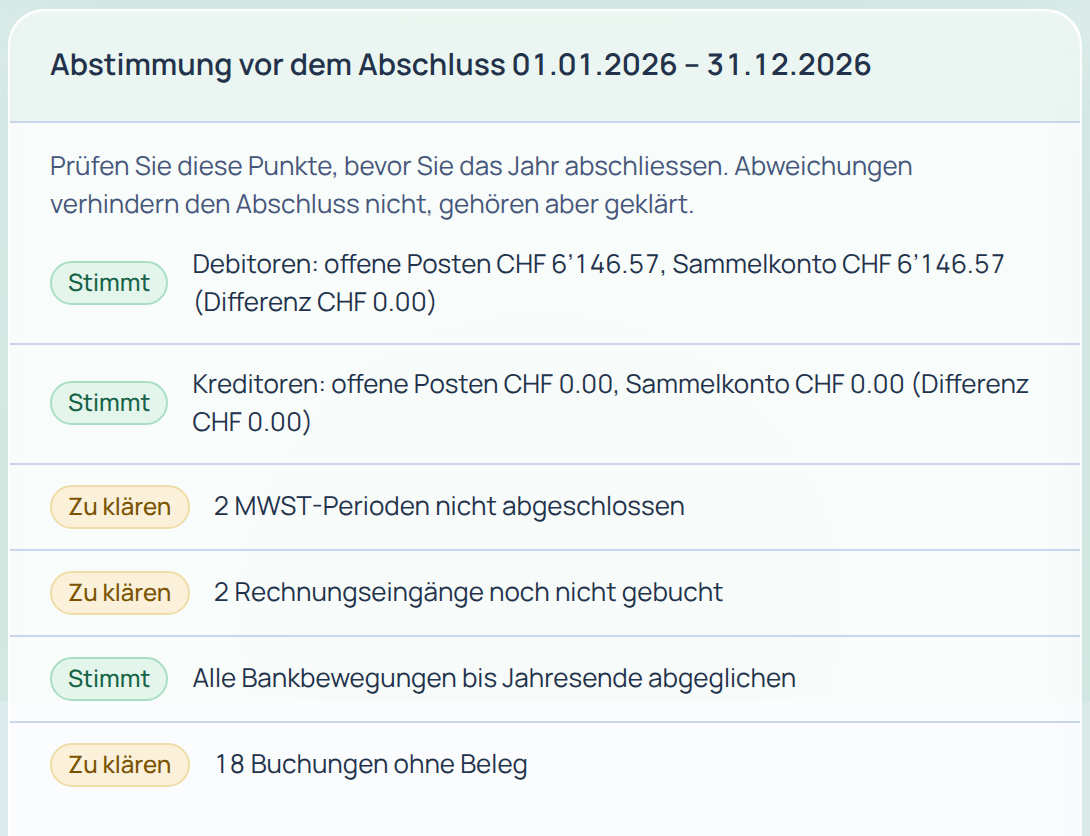
6. Closing. Under Closing, Finance checks year-end receivables/payables against control accounts, open VAT periods, incoming invoices and bank transactions, and entries lacking evidence. A fixed ten-entry sample supports the fiduciary.
See the Finance | base guide for detailed instructions. Try the Demo or open a test account. Questions? See the Contact page.
Sources
- Code of Obligations (OR, SR 220), Art. 75; Art. 85, para. 1; Art. 86, paras. 1–2; Art. 87, para. 1; Art. 102; Art. 127; Art. 128, points 1 and 3; Art. 129; Art. 130, para. 1; Art. 132, para. 1; Art. 133; Art. 135; Art. 137, para. 1; Art. 138, para. 2; Art. 142, as at 1 October 2026: Fedlex (German original), accessed 26.10.2026.
- Code of Obligations (OR, SR 220), Art. 957a, para. 2; Art. 958f, para. 1; Art. 960, paras. 1 and 3, as at 1 October 2026: Fedlex (German original), accessed 26.10.2026.
- Ordinance on the Keeping and Retention of Accounts (Ordinance on Accounting Records, GeBüV, SR 221.431), Art. 1, paras. 1 and 3, as at 1 January 2013 (version available on Fedlex on 26.10.2026): Fedlex (German original), accessed 26.10.2026.
This guide does not replace legal or tax advice. Information as at 26 October 2026.