
An SME chart of accounts is the framework of your bookkeeping: every posting goes to an account, and each account has a number and name. Setting up a chart of accounts for your SME determines what the balance sheet and income statement will look like, how well you can analyse the figures and how much work your fiduciary faces at closing. This guide explains how a chart of accounts is structured, what the law says, how the accounting framework commonly used for Swiss SMEs is organised and how to add, transfer and deactivate accounts properly.
Accounting framework and chart of accounts: the difference
Two terms are often confused. The accounting framework is a classification structure with account classes, groups and example accounts. The chart of accounts is the specific list of accounts your business actually maintains. It is derived from the framework: take the accounts you need, omit others and add your own.
The authors of the school accounting framework expressly state that individual accounts may be omitted and others added from the Swiss SME accounting framework, provided the structure is preserved. This is the basic rule for your chart of accounts: retain the structure, adapt the scope.
What the law requires
The Code of Obligations does not prescribe a particular chart of accounts; Articles 957 to 959c contain no mandatory accounting framework. However, it sets requirements that a chart of accounts must meet:
- Systematic recording and verifiability (Art. 957a of the Code of Obligations (CO, OR), para. 2): Business transactions must be recorded completely, truthfully and systematically, every posting needs a voucher, and bookkeeping must be clear and verifiable. It must also suit the nature and size of the business. A clearly structured chart of accounts is the main tool for this.
- Minimum balance sheet classification (Art. 959a CO): Assets must separately show, at a minimum, cash and cash equivalents together with short-term assets with quoted market prices, trade receivables, other short-term receivables, inventories and unbilled services, and prepaid expenses and accrued income, followed by non-current assets with financial assets, participations, tangible fixed assets, intangible assets and unpaid share, company or foundation capital. Current liabilities, non-current liabilities and equity must appear in the prescribed order on the liabilities and equity side.
- Minimum income statement classification (Art. 959b CO): It may be presented by nature of expense or by function of expense. Under the nature-of-expense method, it shows at least net proceeds, changes in inventories, materials expense, personnel expense, other operating expense, depreciation and value adjustments on non-current assets, financial expense and income, non-operating expense and income, extraordinary, non-recurring or prior-period expense and income, direct taxes, and annual profit or loss.
- Prohibition of offsetting (Art. 958c CO, para. 1, no. 7): Assets and liabilities, and expenses and income, must not be offset against each other. A chart of accounts should therefore keep, for example, revenue and revenue reductions in separate accounts.
- Sector adaptation (Art. 958c CO, para. 3): While preserving the statutory minimum content, financial reporting must reflect the specific features of the business and sector.
- Separate disclosure (Art. 959a CO, para. 4): Receivables and liabilities involving equity holders, governing bodies and companies in which participations are held must be disclosed separately in the balance sheet or notes. Dedicated accounts make this easier.
Important: this minimum classification applies to annual financial statements under Art. 958 et seq. CO. Anyone required only to record income, expenses and financial position does not need a balance sheet; Bookkeeping obligations for SMEs explains which obligations apply to your business, and Income-and-expense accounting or double-entry bookkeeping? gives more on the two forms.
The nine account classes
The widely used Swiss SME accounting framework is divided into nine classes. The following overview comes from SwissAccounting’s official school edition. It is practice and a sector standard, not law.
| Class | Name | Examples |
|---|---|---|
| 1 | Assets | 1000 Cash, 1020 Bank balances, 1100 Trade receivables (debtors) |
| 2 | Liabilities and equity | 2000 Trade payables (creditors), 2200 Output tax, 2800 Share, company, cooperative or foundation capital (legal entities) |
| 3 | Operating income from goods and services | 3000 Production revenue, 3400 Service revenue |
| 4 | Expenses for materials, merchandise, services and energy | 4000 Production materials expense, 4200 Merchandise expense |
| 5 | Personnel expense | 5000 Wage expense, 5700 Social insurance expense |
| 6 | Other operating expenses, depreciation and value adjustments, and financial result | 6000 Premises expense, 6800 Depreciation, 6900 Financial expense |
| 7 | Ancillary operating result | 7000 Income from ancillary operations, 7500 Income from business property |
| 8 | Non-operating, extraordinary, non-recurring or prior-period expenses and income | 8000 Non-operating expense, 8900 Direct taxes |
| 9 | Closing | 9200 Annual profit or loss |
Classes 1 and 2 form the balance sheet, classes 3 to 8 the income statement, and class 9 serves closing. Within classes, accounts follow number ranges: two-digit groups such as 10 (current assets), 14 (non-current assets), 20 (current liabilities), 24 (non-current liabilities) and 28 (equity) group the accounts. Equity has variants by legal form: the school edition distinguishes legal entities, sole proprietorships and partnerships.
How the framework fits the minimum classification
The framework can be read so that number ranges reveal the minimum balance sheet classification under Art. 959a CO. This is our interpretation, not a statutory requirement. On the assets side, groups 100, 106, 110, 114, 120 and 130 follow the statutory order from cash and cash equivalents to prepaid expenses and accrued income. Non-current assets then comprise financial assets, participations, movable and immovable tangible fixed assets, and intangible assets. The liabilities and equity side follows with trade payables, short-term interest-bearing and other liabilities, accrued expenses and deferred income, non-current liabilities and equity. There is a difference for provisions: Art. 959a CO, para. 2, no. 2, let. c allocates them to non-current liabilities, while framework group 230 also contains short-term provisions. Classes 3 to 8 can be read as the nature-of-expense method under Art. 959b CO, para. 2; however, class 7’s ancillary operating result has no dedicated equivalent there. Keeping to the number ranges makes it easier to compile the statutory financial statement items from the accounts.
Creating, deactivating and importing accounts
Add an account. If you need a distinction not provided by the framework, create your own account: in the right class and group, with a number fitting the sequence and a clear name. For reporting, the number must match the account class.
Deactivate rather than delete. An account already used for postings must not disappear, because postings and vouchers must be retained (Art. 958f CO, ten years). Deactivation is therefore practical: the account can no longer be selected, while old postings remain readable.
Transfer an existing chart of accounts. If you already have a chart of accounts, for example from previous software, import it as a file. A dry run matters: before anything is saved, you should see what will be created and where warnings or errors occur.
Naming conventions. Keep names short and unambiguous. Do not change numbers after the first postings; postings and reports depend on them.
Practical example: Muster Elektro GmbH
Muster Elektro GmbH is a fictional installation company with six employees. It adopts the SME accounting framework and sets the following account balances at 31 December 2026:
| Account | Name | CHF |
|---|---|---|
| 1000 | Cash | 2’400.00 |
| 1020 | Bank | 58’600.00 |
| 1100 | Trade receivables | 41’000.00 |
| 1200 | Inventories | 18’000.00 |
| 1520 | Office machines, IT | 12’000.00 |
| Total assets | 132’000.00 | |
| 2000 | Trade payables | 19’500.00 |
| 2200 | Output tax | 6’500.00 |
| 2400 | Long-term bank liabilities | 30’000.00 |
| 2800 | Company capital | 20’000.00 |
| 2960 | Voluntary retained earnings | 31’000.00 |
| 2979 | Annual profit | 25’000.00 |
| Total liabilities and equity | 132’000.00 |
Check: assets 2’400 + 58’600 + 41’000 + 18’000 + 12’000 = 132’000. Liabilities and equity 19’500 + 6’500 + 30’000 + 20’000 + 31’000 + 25’000 = 132’000. Both sides are equal.
The statutory classification follows almost automatically: cash and cash equivalents 61’000 (1000 plus 1020), trade receivables 41’000, inventories 18’000, together current assets 120’000; plus tangible fixed assets 12’000. Current liabilities are 26’000 (19’500 plus 6’500), non-current liabilities 30’000, equity 76’000 (20’000 plus 31’000 plus 25’000).
The company uses cloud software for quotes and wants to see these costs separately. The framework has account 6570 “IT expenses including leasing”. Alongside it, the company creates its own account 6571 “Cloud subscriptions”. The number stays in the correct class, and costs remain reportable under other administrative expenses.
The company does not need the prepared account “1060 Securities”. It deactivates it rather than deleting it.
Checklist
- Legal form and bookkeeping type clarified (double-entry or income-and-expense accounting)
- Appropriate template chosen (legal form, with or without VAT liability)
- Number ranges match classes 1 to 9
- Minimum classification under Art. 959a and 959b CO derivable from accounts
- Accounts for equity holders and governing bodies kept separately (Art. 959a CO, para. 4)
- Own accounts placed in the correct group, clearly named
- Unneeded accounts deactivated rather than deleted
- For imports: error-free dry run, warnings reviewed
- Chart of accounts saved as a file
- Agreed with the fiduciary
How KMU | base helps
The screenshots show the interface in German; KMU | base is also available in French, Italian and English.
1. Start with the SME accounting framework. In Finance | base, start with 99 prepared accounts in its own version following the Swiss SME accounting framework, including receivables and payables control accounts and VAT and payroll accounts.
2. Choose a template during setup. When setting up bookkeeping, choose one of six templates: SME with or without VAT, sole proprietorship with or without VAT (owner’s equity and private account instead of share capital), association (association capital, membership fees, donations, events), or micro business with around 35 accounts. Each template first provides an explanation and account preview.
3. Create and deactivate accounts. Under Sidebar › More › Accounts (the “More” group at the end of the sidebar is collapsed), view the chart of accounts. With the “Manage” level, use Create account to add accounts with number, name, VAT proposal and cash-account flag. Set unneeded accounts to inactive; number and type remain because postings depend on them. The list appears first; open the entry form when needed.
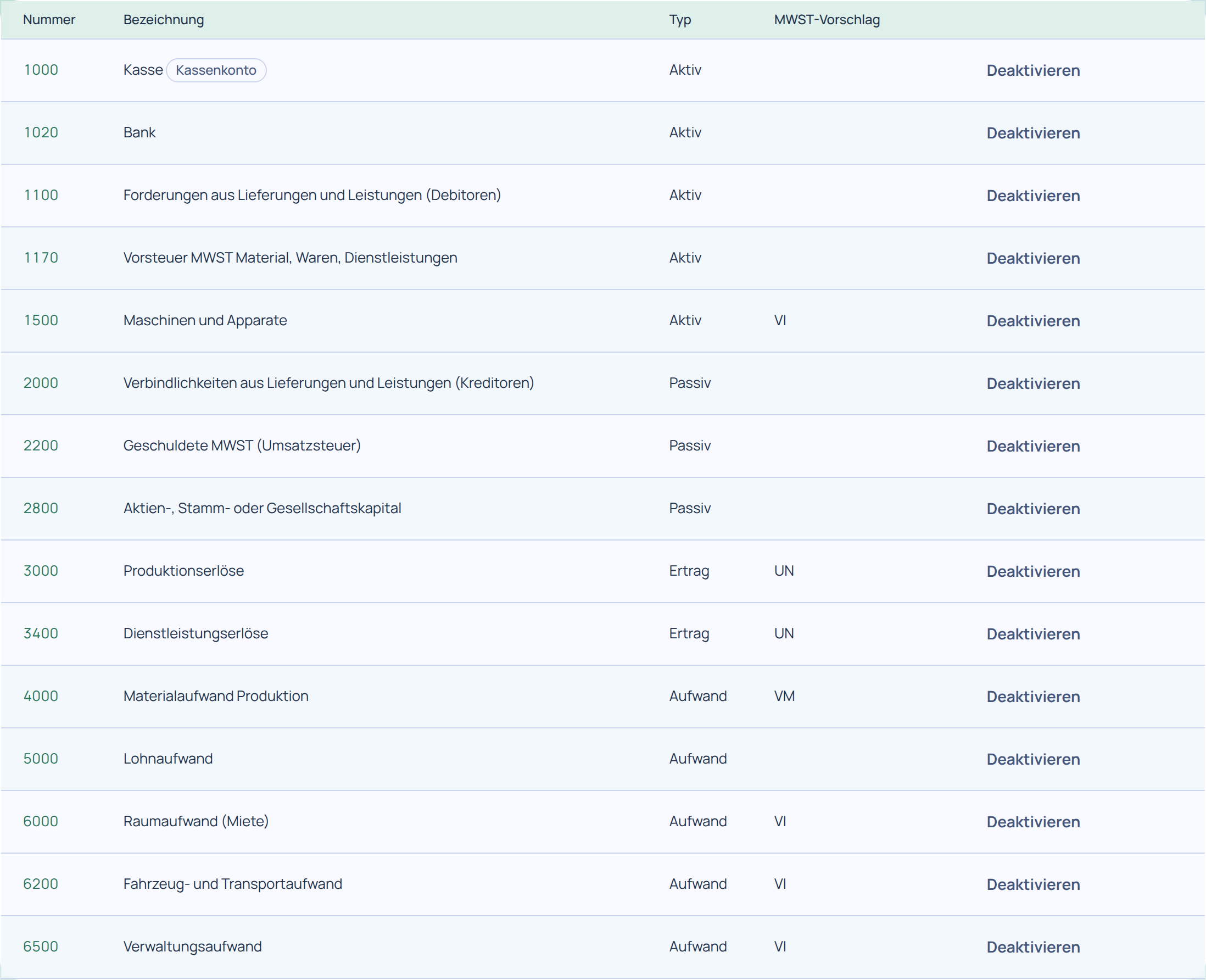
4. Import your previous chart of accounts. In the same Create account expandable area, upload your previous chart of accounts as CSV or Excel. A dry run first provides a report: what would be created, plus warnings and errors with reasons. Finance warns if the type does not match the account class and checks the VAT code against valid codes. Only afterwards are new numbers created.
5. Export and reuse. Download the chart of accounts as CSV or Excel, in exactly the import format. It can then be imported into another company.
To try it yourself, view the demo or open a trial account. The module guide is under Finance guides. For questions, use our Contact page.
Sources
- Code of Obligations (CO, OR, SR 220), Art. 957a, para. 2, Art. 958c, para. 1, no. 7 and para. 3, Art. 958f, para. 1, Art. 959a, paras. 1, 2 and 4, and Art. 959b, paras. 1 and 2, as at 1 October 2026: fedlex.admin.ch (German original), accessed on 26.10.2026.
- SwissAccounting, Zürich: “Swiss SME Accounting Framework: Official School Edition” (Mattle, Helbling, Pfaff), account classes, groups and example accounts, and the authors’ note on omitted and added accounts: kmu.admin.ch (PDF, in German), accessed on 26.10.2026. The framework is a practical recommendation, not a statutory requirement.
This guide does not replace legal or tax advice. Information as at 26 October 2026.