
Starting year-end work only in spring wastes time on tasks best done calmly in December. This year-end checklist covers reconciliations, inventory, accruals, depreciation, VAT, finalisation, Swiss deadlines and approval. It applies to businesses required to prepare financial statements. Those keeping only income, expenditure and financial-position records under Art. 957, para. 2 of the Code of Obligations (OR; CO) need no annual report and can simplify these steps.
What year-end accounts include
Art. 958, para. 2 CO requires an annual report containing annual financial statements: balance sheet, income statement and notes. Show prior-year figures alongside current figures (Art. 958d, para. 2); balance sheet/income statement may use account or report format (para. 1).
Art. 959a/959b prescribe minimum balance-sheet/income-statement structures; notes supplement/explain them (Art. 959c). Sole proprietorships/partnerships may omit notes unless subject to larger-company reporting (para. 3); AG/GmbH cannot.
Provide evidence for the individual items in the balance sheet and notes through inventories or other means (Art. 958c, para. 2). The figures must remain separately visible: assets may not be offset against liabilities, and expenses may not be offset against income (para. 1, point 7). These requirements apply when preparing the statements from the completed bookkeeping records.
Deadlines
| Task | Deadline | Basis |
|---|---|---|
| Prepare annual report and submit to competent body | Within six months of year-end | Art. 958, para. 3 CO |
| Ordinary general meeting (AG) | Annually within six months of year-end | Art. 699, para. 2 |
| Ordinary members’ meeting (GmbH) | Annually within six months of year-end | Art. 805, para. 2 |
| Convene GmbH meeting | At least 20 days beforehand; articles may extend or shorten to ten | Art. 805, para. 3 |
| Retain books, records and annual report | Ten years from year-end | Art. 958f, para. 1 |
For calendar-year 2026, six months ends Wednesday, 30 June 2027. The chair of the highest management/administrative body and person responsible for accounting sign the report (Art. 958, para. 3); retain it written and signed (Art. 958f, para. 2).
Seven-step checklist
1. Complete postings and reconcile accounts
Record all transactions through reporting date, including supplier invoices, expenses and cash. Each entry needs evidence (Art. 957a, para. 2, point 2 CO). Reconcile balance-sheet accounts externally:
- Bank/post/cash: 31 December balances match statements/counts. Allocate open bank transactions first.
- Receivables/payables: open invoices total respective control accounts; differences suggest errors/unposted payments.
- Clearing/transit: zero or explainable at reporting date.
2. Record and value inventories
Count at reporting date or use continuous records. If selling value less remaining costs is below acquisition/production cost, use it (Art. 960c, para. 1). Inventories include raw materials, work in progress, finished goods and merchandise (para. 2). Difference from recorded inventory affects results as an inventory change. See Stocktake.
3. Accruals and provisions
Allocate expenses/income to the correct periods and subjects (Art. 958b, para. 1). Check:
- Prepayments: insurance partly covering next year.
- Accrued expenses: electricity invoiced in January.
- Unbilled services and advances received.
- Provisions: past events suggesting future outflows require estimated provisions charged to income (Art. 960e, para. 2).
Where net sales/service revenue or financial income does not exceed CHF 100’000, businesses may dispense with temporal accruals and use receipts/payments (Art. 958b, para. 2). Optional, not mandatory.
4. Depreciate assets
Depreciation reflects use/age-related loss (Art. 960a, para. 3). Update register, post annual depreciation and disposals. Concrete overvaluation signs require review (Art. 960, para. 3). See Asset accounting and depreciation.
5. Reconcile VAT
FTA guidance requires submitted returns reconciled with annual accounts. No defects means no submission. For defects identified in annual reconciliation, use only “Annual reconciliation (adjustment return under Art. 72 MWSTG)”, declaring differences from submitted returns. Period correction returns serve individual monthly, quarterly or half-yearly corrections.
Art. 72, para. 1 of the VAT Act (MWSTG) requires year-end defects corrected no later than the return for the period containing day 180 after year-end. The FTA page specifies 240 days: absent adjustment, it assumes returns complete/correct. For 2026, that is Saturday, 28 August 2027. Errors corrected only in annual reconciliation incur default interest according to the FTA. Clarify cases with the FTA/fiduciary. See Swiss VAT returns and Input tax and VAT corrections.
6. Review, lock and close
Read statements together: balanced balance sheet, prior-year figures, plausible result? Finalise only after fiduciary, auditor or management accepts figures; changes are then restricted.
7. Notes, signatures, approval and filing
Complete Art. 959c notes, including policies, explanations of statement items, average annual FTE declaration (not over 10, over 50 or over 250), pension-institution liabilities and material subsequent events unless already apparent.
AG general meetings have non-transferable authority to approve annual statements and allocate balance-sheet profit (Art. 698, para. 2, point 4); GmbH members’ meetings likewise (Art. 804, para. 2, point 5). File signed report and resolution.
Practical example: Muster Holzbau GmbH
Fictional Muster Holzbau GmbH uses calendar years. Before closing entries, 2026 profit is CHF 118’700.00, already including the payable-error correction below. December reconciliations show:
- Receivables: open CHF 84’320.00; control CHF 84’320.00; difference CHF 0.00.
- Payables: open CHF 61’280.00; control CHF 61’820.00; difference CHF 540.00. Supplier invoice posted CHF 2’830.00 instead of CHF 2’290.00 (2’830 − 2’290 = 540); expense overstated CHF 540.00. Reverse/repost; correction already included in CHF 118’700.00.
Closing effects:
| Item | Profit effect CHF |
|---|---|
| Profit before closing entries (after payable correction) | 118’700.00 |
| Stock counted CHF 36’950.00 versus recorded CHF 38’200.00: decrease CHF 1’250.00 | −1’250.00 |
| Accrued November/December electricity, invoiced January 2027 | −2’340.00 |
| Prepaid insurance CHF 3’600.00 for 1 July 2026–30 June 2027, paid 1 July 2026; six/twelve months concern 2027 (3’600 × 6 / 12) | +1’800.00 |
| Subtotal after inventory/accruals | 116’910.00 |
| Register depreciation | −9’200.00 |
| 2026 result | 107’710.00 |
118’700 − 1’250 − 2’340 + 1’800 = 116’910; less 9’200 = 107’710.
Prepare/submit the report by Wednesday, 30 June 2027. Members meet Tuesday, 8 June 2027; absent different articles, convene by Wednesday, 19 May 2027, 20 days earlier. Retain 2026 documents through end-2036. Allow auditor time where applicable; set internal deadlines earlier than law requires.
Tick-off checklist
- All transactions through reporting date posted with evidence
- Bank/post/cash reconciled to statements/counts
- Receivable/payable open items match control accounts
- Inventory established; Art. 960c valuation checked
- Prepayments/accruals posted
- Provisions reviewed (Art. 960e, para. 2)
- Asset register updated; depreciation/disposals posted
- VAT reconciled; defects reported using FTA annual-reconciliation form (Art. 72 MWSTG)
- Statements/prior year reviewed; result plausible
- Months locked, year closed, balances carried forward
- Art. 959c notes completed unless exemption applies
- Signed report submitted within six months
- General/members’ meeting approval minuted
- Ten-year retention ensured
How KMU | base helps
The screenshots show the German interface; KMU | base is also available in French, Italian and English.
Closing pages are in Finance’s Accounting sidebar group; assets under More. Legal completeness remains the company’s responsibility.
1. Reconcile. Accounting › Closing checks year-end receivables/payables against control accounts, open VAT periods, incoming invoices, bank movements and unsupported entries, plus a fixed ten-entry fiduciary sample. Differences do not block closing but need clarification.
2. VAT/form. VAT returns show posted tax and differences before closing. Finance has no FTA Art. 72 annual-reconciliation form. Correction returns recalculate one period and show only differences from its submitted version.
3. Statements. Accounting › Reports displays grouped dated balance sheets with prior-year figures and balancing indication, report-format income statements with prior-year comparison, and trial balances showing debit, credit and balance.
4. PDF. Reports downloads report-format statements at the selected date with available prior-year figures and notes guidance; missing prior-year data is marked. Notes are not fully completed: add policies, material-item explanations and other Art. 959c disclosures separately. eBilanz-taxonomy handover is not implemented.
5. Lock/close. Closing irreversibly locks checked months and earlier open months in that year. Locked months/closed years reject entries; reversals targeting them post today. Close year creates the next year, carries balance-sheet balances, transfers profit to retained earnings and locks all months. Post depreciation, accruals and inventory changes beforehand. Enter profit-appropriation resolutions manually afterwards.
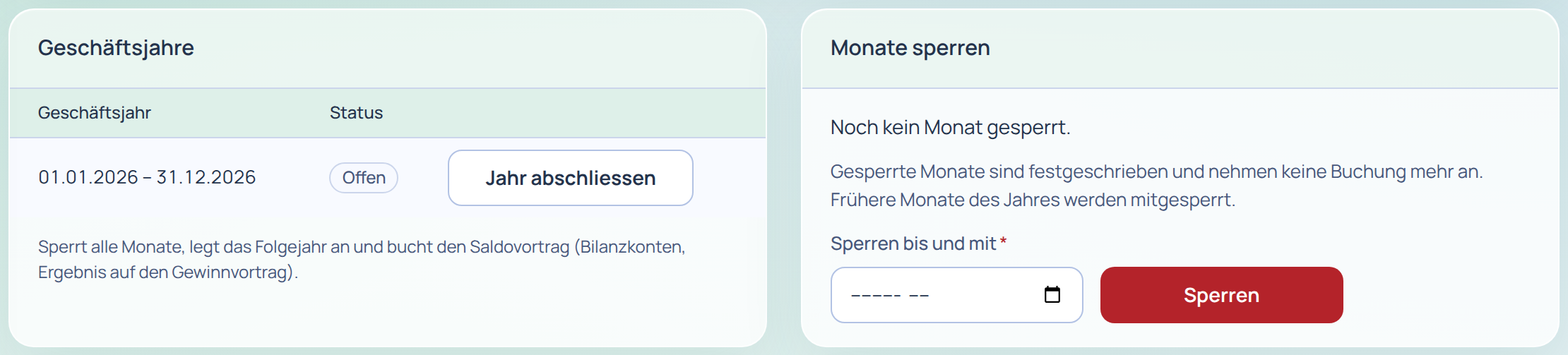
6. Evidence. The closed year’s CSV trial balance is stored unalterably with supporting records, linked to the carry-forward entry.
Try the Demo or open a test account. The Finance | base guide details steps. Questions? See the Contact page.
Sources
- Code of Obligations (OR, SR 220), Art. 957, para. 2; Art. 957a, para. 2; Art. 958, paras. 2–3; Art. 958b; Art. 958c, paras. 1–2; Art. 958d, paras. 1–2; Art. 958f, paras. 1–2; Art. 959a, 959b, 959c; Art. 960, para. 3; Art. 960a, para. 3; Art. 960c; Art. 960e, para. 2; Art. 698, para. 2; Art. 699, para. 2; Art. 804, para. 2; Art. 805, paras. 2–3, as at 1 October 2026: Fedlex (German original), accessed 26.10.2026.
- VAT Act (MWSTG, SR 641.20), Art. 72, para. 1, as at 1 January 2025: Fedlex (German original), accessed 26.10.2026.
- Federal Tax Administration: Annual VAT reconciliation (in German), 240-day adjustment-return deadline, accessed 26.10.2026.
This guide does not replace legal or tax advice. Information as at 26 October 2026.