
A warehouse stocktake can mean a day counting and an evening puzzling over differences. Yet it directly compares books with shelves, revealing errors, shrinkage and slow movers, and supplies the balance-sheet inventory figure. This guide covers legal evidence, sound counting, blind counts, differences and valuation.
Legal inventory requirements
Art. 958c, para. 2 of the Code of Obligations (OR; CO) requires evidence for individual balance-sheet/notes items through inventories or other means. It specifies neither method nor frequency and does not expressly require physical counting on a particular day.
Two distinctions:
- Who: Art. 958c concerns financial reporting. Under Art. 957, para. 1, this covers sole proprietorships/partnerships with at least CHF 500’000 prior-year revenue and legal entities, e.g. AG/GmbH. Below CHF 500’000, sole proprietorships/partnerships and certain associations/foundations need only income, expenditure and financial-position records (para. 2). Discuss inventory evidence with your fiduciary.
- Continuous records: Art. 1, para. 3 of the Ordinance on Accounting Records (GeBüV) includes continuous stock records among subsidiary ledgers according to business type/size. Stocktaking compares recorded with actual quantities.
In practice, businesses normally count their warehouse once a year at the balance-sheet reporting date. This is a common way of organising the work, rather than a statutory prescription for a particular counting day or frequency.
When and how to count
Common practical methods, not legal requirements:
- Reporting-date count: all stock in one day, usually reporting date. Clear overview but requires movements to stop.
- Rolling count: spread through the year, e.g. bin by bin. Requires accurate continuous records for every receipt/issue.
Agree whether a simplified method suffices with your fiduciary or auditor.
Preparation and blind counting
- Set the date and counting window. If possible, stop goods movements while the count takes place. If movements must continue, define a procedure for recording them afterwards so that they can be taken into account.
- Organise the warehouse. Use clearly identified bins and labelled compartments, and keep identical goods together. Separate damaged or expired goods and record them separately.
- Assign the counters. Ideally, the person counting the goods should not also be the person who posts the stock.
- Count blind. Do not show counters the quantities in the books. Someone who knows the expected quantity may unconsciously count towards that figure or stop looking once it is reached. Without that figure, the counter records what is actually in the bin.
- Recount unusual results. Where a line shows a substantial difference, ask a second person to count it again before the difference is posted.
For goods tracked by batch or expiry date, carry out the count separately for each batch. Keep the results separate too: a shortage in batch A cannot simply be offset against a surplus in batch B. The distinction matters when comparing what is recorded with what is actually present.
Understand and post differences
Difference = counted minus book stock: negative shrinkage, positive surplus. Common causes:
- missing/duplicate receipt or delivery postings;
- wrong bin/item;
- similar items or units confused, e.g. boxes versus units;
- breakage, shrinkage, theft;
- unposted transfers.
Find and fix causes first. Post adjustment movements instead of deleting differences, preserving stock history. GeBüV Art. 3 requires detectable changes to books/records.
A line that nobody has counted is not a line with a quantity of zero. A missing count is a gap in the stocktake, which you should resolve before closing it. Finance | base allows a stocktake to close even when some lines are uncounted; those lines remain unchanged. You therefore need to check completeness yourself before closure.
Value stock at reporting date
Quantity needs value. Acquisition/production cost is the ceiling (Art. 960a, paras. 1–2 CO). Use lower selling value less remaining costs at reporting date (Art. 960c, para. 1). Review slow, damaged and expired goods while counting. Assets normally require individual valuation (Art. 960, para. 1). Art. 960a, para. 4 allows additional depreciation/value adjustments for replacement and lasting business prosperity; clarify limits with your fiduciary.
Counted, valued quantities must reach the general ledger: adjust the inventory account to stock value. The difference is an inventory change.
Count sheets support this entry. Art. 957a, para. 3 CO defines supporting records as paper/electronic evidence needed to understand underlying transactions or circumstances. We therefore recommend retaining count logs like supporting records: ten years from financial year-end (Art. 958f, para. 1).
Practical example: Muster Gartenbedarf GmbH
Fictional retailer Muster Gartenbedarf GmbH in Musterhausen closes Thursday, 31 December 2026. During the holiday shutdown, staff count the main warehouse. Four-line extract:
| Bin | Item | Book | Counted | Difference | Ø Cost (CHF) | Difference value (CHF) |
|---|---|---|---|---|---|---|
| A-01 | Potting soil 40 l | 118 | 116 | −2 | 4.10 | −8.20 |
| A-02 | Terracotta flowerpot 20 cm | 240 | 240 | 0 | 2.60 | 0.00 |
| B-01 | Lawn fertiliser 5 kg | 36 | 35 | −1 | 18.50 | −18.50 |
| B-02 | Garden hose 20 m | 15 | 16 | +1 | 32.00 | +32.00 |
| Extract total | +5.30 |
Checks find an unposted hose receipt delivery note and a torn fertiliser bag disposed of. Soil remains unexplained; warehouse management still posts the difference. Total: −8.20 − 18.50 + 32.00 = +CHF 5.30.
Counters also identify 50 winter-fertiliser bags after season-end with damaged packaging. Cost CHF 12.00 each; expected proceeds net of remaining costs CHF 9.00. Art. 960c, para. 1 requires 50 × (12.00 − 9.00) = CHF 150.00 write-down. Post manually in the journal to a contra-asset “Inventory value adjustment”, e.g. create 1209, against expense; not through stock valuation or directly to 1200.
After stocktake posting, cost-based inventory is CHF 151’920.00; account 1200 shows CHF 142’380.00. Increase 151’920.00 − 142’380.00 = CHF 9’540.00: debit 1200 Inventory, credit 4280 Inventory changes. The 2026 annual report is due within six months, by 30 June 2027 (Art. 958, para. 3 CO). Retain count documents with 2026 records through end-2036.
Checklist
- Date, window and location defined
- Warehouse organised; bins unique; rejected/expired goods separate
- Counters assigned; blind counts
- Batch/expiry goods counted by batch
- All lines counted; no gaps
- Anomalies recounted and causes clarified
- Movements during counting checked before closing
- Differences posted as adjustments; nothing overwritten
- Slow/damaged/expired goods assessed for lower value
- Inventory change posted; count log filed for ten years
How KMU | base helps
The screenshots show the German interface; KMU | base is also available in French, Italian and English.
Count by location, bin and batch under Personal › Stock, tab Stocktake.
1. Prepare bins. Batch-create, e.g. A-01–A-20, and print QR/barcode labels per bin under More › Locations. Batch labels include number/best-before date.
2. Start. Select location/reporting date. Sheets include all items stocked in that location’s bins; add lines without expected stock. Optionally print sheets by bin without input controls for paper counting.
3. Blind count. Counters see neither expected quantity nor difference, including batch lines. Use the sheet or Scan › Stocktake with camera/hand scanner.
4. Review/close. Review and difference posting require “Manage stock”. Management sees starting expected stock, current stock, net movements since start and adjustment. Counted quantity becomes closing stock; counted minus current is posted exactly once with closure. Stale previews require fresh review. Uncounted lines stay unchanged; no counting after closure.
5. Value/post. More › Valuation shows dated values per item using moving average, FIFO or standard cost. Accounting › Closing, “Change in merchandise inventory”, compares value with account 1200 and posts the difference against 4280 in one click.
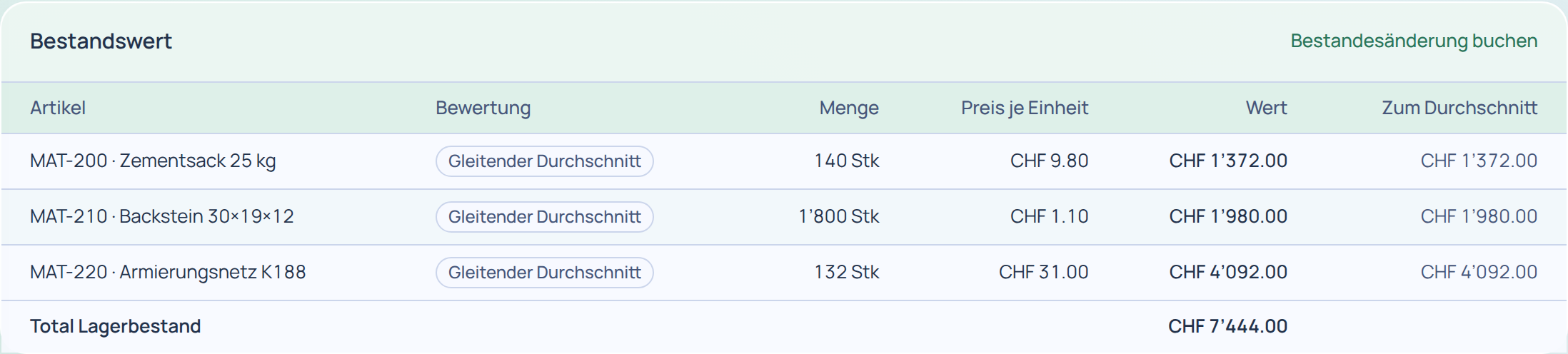
Your judgement: Finance uses cost, not automatic Art. 960c lower values. Post write-downs manually to a contra-asset “Inventory value adjustment”, e.g. create 1209, against expense. Do not write directly to inventory: inventory-change posting would realign it to stock value. Fixed accounts 1200 “Merchandise”/4280 suit merchandise only, not raw materials/finished goods. Agree treatment with your fiduciary.
Try the Demo or open a test account. See Stock management, Year-end checklist and Bookkeeping obligations. Questions? See the Contact page.
Sources
- Code of Obligations (OR, SR 220), Art. 957, paras. 1–2; Art. 957a, para. 3; Art. 958, para. 3; Art. 958c, para. 2; Art. 958f, para. 1; Art. 960, para. 1; Art. 960a, paras. 1, 2 and 4; Art. 960c, para. 1, as at 1 October 2026: Fedlex (German original), accessed 26.10.2026.
- Ordinance on the Keeping and Retention of Accounts (Ordinance on Accounting Records, GeBüV, SR 221.431), Art. 1, para. 3 and Art. 3, as at 1 January 2013 (version available on Fedlex on 26.10.2026): Fedlex (German original), accessed 26.10.2026.
Stocktake methods (reporting-date, rolling), blind-count advice and count-log retention recommendations are practical explanations, not statutory prescriptions.
This guide does not replace legal or tax advice. Information as at 26 October 2026.