
Inventory ties up money. Shortages cost orders; excess costs space, capital and potentially write-downs. Stock management balances both risks: know what is where, reorder promptly, value correctly and compare records with shelves. This guide explains concepts and calculations, Swiss inventory law and practical efficiency.
What stock management covers
Four questions: what is where, what is available, when to reorder, and what is it worth?
- Location and bin: a location can be a warehouse, branch or vehicle. A bin is the individual compartment within it, such as “A-03-2”. Keeping bin records helps people find goods faster and count a particular part of the warehouse.
- On hand, reserved and available: on-hand stock is the quantity physically present. Reserved stock is the part set aside for confirmed orders. Available stock is the on-hand quantity minus the reserved quantity. When deciding whether to reorder, use the available quantity rather than simply looking at how much is on the shelf.
- Movements: every receipt, issue, transfer and adjustment is a stock movement with a date and source. These movements let you reconstruct how the recorded stock arose.
Art. 1, para. 3 of the Ordinance on Accounting Records (GeBüV) expressly includes continuous inventory records among subsidiary ledgers, alongside payroll, receivables and payables, according to business type/size. Continuous stock records may therefore be required beside the general ledger.
Minimum stock, reorder point and target
These are business concepts, explained here from practice, not statutory duties. Terminology varies: teaching often uses “minimum stock” for safety stock; KMU | base uses it for the reorder point.
- Safety stock: buffer against variable consumption/late delivery, normally untouched.
- Reorder point: daily requirement × delivery days + safety stock, so supplies arrive before the buffer is needed.
- Target stock: replenishment level, constrained by space, capital and expiry risk.
- Order quantity: target minus available minus already ordered, at least supplier minimum order quantity.
At 10 units daily and seven delivery days, waiting needs 10 × 7 = 70. Three buffer days add 30: reorder point 100. Enter 100 as “Minimum stock” in KMU | base. Running replenishment proposes orders when available plus ordered falls below it; nothing orders itself. Review at least annually, especially seasonal goods/new suppliers.
Ordering and receiving
The usual sequence starts with replenishment: it identifies items below their minimum and proposes the quantity to order. A proposal then becomes a supplier order. When the goods arrive, record the receipt in a bin. If the supplier delivers the order in several parts, post each partial delivery separately.
The cost price entered with a receipt determines the value of the goods in stock. If you use moving average, recalculate it after every receipt: (old quantity × old price + new quantity × new price) ÷ total quantity. When you buy the same item at different prices, this calculation produces a blended price for the resulting stock.
Valuation under the Code of Obligations
Art. 959a, para. 1 of the Code of Obligations (OR; CO) requires separate current-asset disclosure of inventories/unbilled services. Inventories include raw materials, work in progress, finished goods and merchandise (Art. 960c, para. 2).
Rules:
- Cost ceiling: initial and subsequent recognition cannot exceed acquisition/production cost (Art. 960a, paras. 1–2).
- Lower value: where selling value less remaining costs at reporting date is lower, use that value (Art. 960c, para. 1), e.g. slow, expired or damaged goods.
- Individual valuation: normally individually for material assets not customarily grouped (Art. 960, para. 1).
- Consistency: apply consistent presentation/valuation standards (Art. 958c, para. 1, point 6); avoid unjustified annual changes.
The CO does not prescribe moving average, FIFO (first purchased, first used) or fixed standard cost. Discuss tax acceptance with your fiduciary.
Metrics: where is your money?
These practical, non-statutory metrics look beyond individual items.
ABC analysis: ranks consumption value (quantity × cost price). A items hold most value and deserve closest monitoring; C covers many low-value lines. KMU | base assigns A while cumulative share before an item is below 80 per cent, B up to 95, the remainder C:
| Item | Annual consumption value (CHF) | Share | Cumulative share before item | Class |
|---|---|---|---|---|
| Cordless lawnmower | 300’000 | 62.5% | 0% | A |
| Hedge trimmer | 100’000 | 20.8% | 62.5% | A |
| Hose trolley | 40’000 | 8.3% | 83.3% | B |
| Flowerpot range | 25’400 | 5.3% | 91.7% | B |
| Potting soil 40 l | 14’600 | 3.0% | 97.0% | C |
Total CHF 480’000; rounded shares total 99.9 per cent. Hedge trimmers remain A although cumulative share afterwards is 83.3 per cent: the preceding share governs.
Turnover: cost of goods used ÷ average stock, where average stock = (opening stock + closing stock) ÷ 2. CHF 480’000 consumption, CHF 110’000 opening and CHF 130’000 closing give CHF 120’000 average, turnover 480’000 / 120’000 = 4.0. Average holding time: 365 / 4 = 91.25, roughly 91 days.
Coverage: quantity ÷ daily consumption. 118 units at 10 daily last around 12 days.
Slow movers: stocked items without issues since a chosen date, e.g. 90, 180 or 365 days. They tie up capital and warrant lower-value review first.
Practical example: Muster Gartenbedarf GmbH
Fictional retailer Muster Gartenbedarf GmbH in Musterhausen sets potting soil 40 l minimum at 100: 10 daily × seven delivery days + 30 buffer. Target 250; supplier minimum order 100.
118 bags on hand minus 22 reserved = 96 available, below 100. Proposed order: 250 − 96 = 154, above minimum 100, so unchanged.
154 bags arrive at CHF 4.20. Existing stock: 118 bags averaging CHF 4.00.
| Line | Quantity | Price (CHF) | Value (CHF) |
|---|---|---|---|
| Old stock | 118 | 4.00 | 472.00 |
| Receipt | 154 | 4.20 | 646.80 |
| New stock (subtotal) | 272 | Ø 4.1132 | 1’118.80 |
Average: 1’118.80 / 272, rounded CHF 4.11. With 22 reserved, 272 − 22 = 250 available, exactly target. Coverage: 272 / 10 = 27.2 days. At year-end, use acquisition cost unless selling value less remaining costs is lower (Art. 960c, para. 1 CO).
Checklist
- Locations/bins defined; stock-managed items marked
- Minimum, target and supplier minimum justified and reviewed annually
- Orders based on proposals
- Receipts include cost price; partial deliveries separate
- Reserved and available distinguished
- Valuation method defined and retained
- Slow/expired goods reviewed before reporting date for lower value
- ABC and turnover analysed at least annually
- Records regularly compared with shelves; see Stocktake
How KMU | base helps
The screenshots show the German interface; KMU | base is also available in French, Italian and English.
Finance | base manages items, bins and movements. Open Personal › Stock with stock-reading rights.
1. Locations/bins. Multiple locations have addresses/bins; every new location receives “HAUPT”. Locations is under More. Create bins in batches, e.g. A-01–A-20.
2. Product settings. Under Sales › Items, enable Stock keeping, set minimum/target, minimum order, supplier, delivery time and default bin. Select moving average, FIFO or standard cost. Set minimum yourself; Finance does not derive it from delivery time.
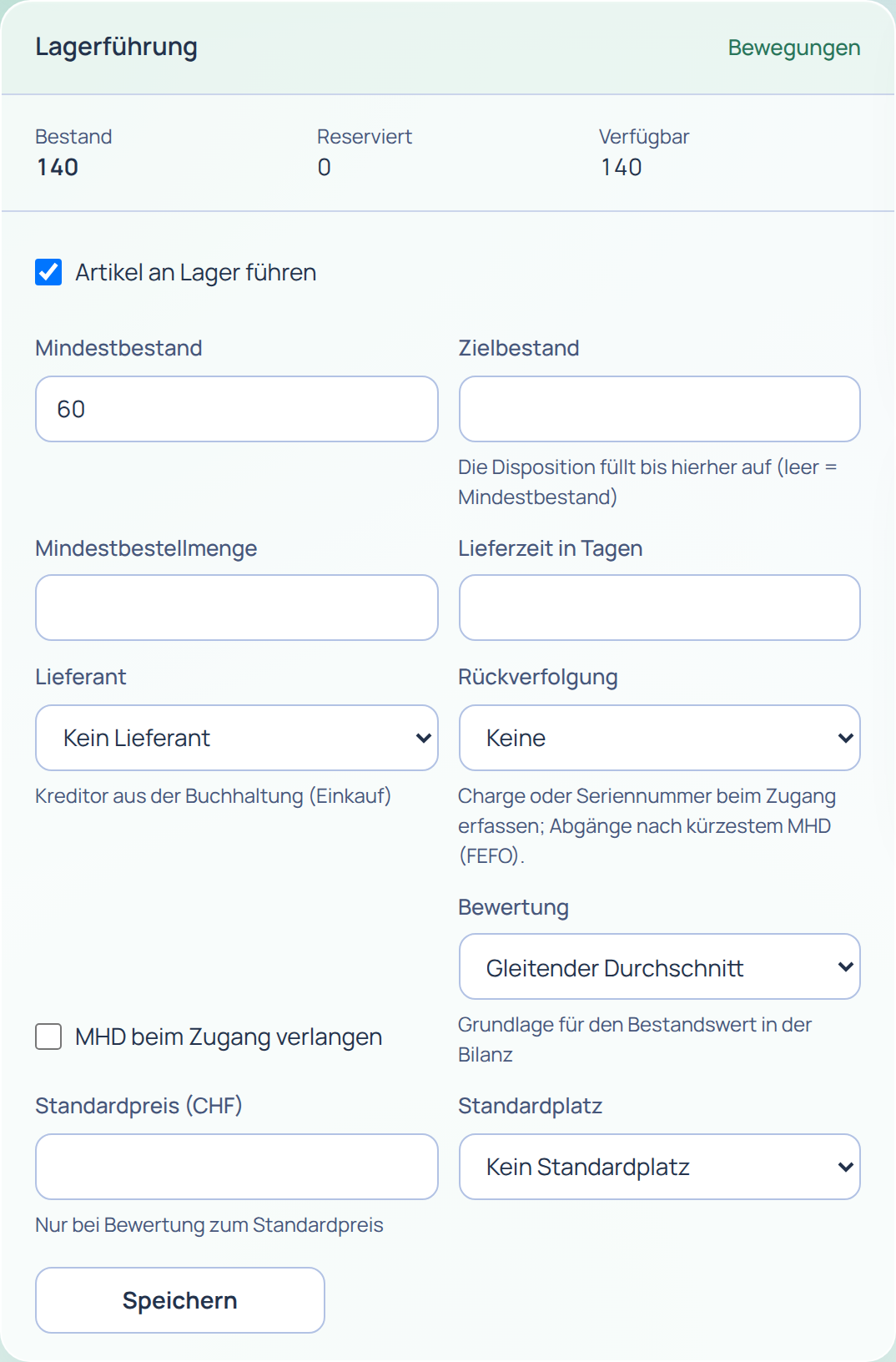
3. Stock. Stock lists on-hand, reserved, available and moving-average value; below-minimum items are marked. Stock without positive average cost shows “without cost price”, not zero value. Post receipts with cost, issues, transfers and adjustments manually. Orders reserve; issuing delivery notes/invoices posts issues at most once per order line. Values require corresponding rights.

4. Proposals. Run replenishment proposes below-minimum items up to target, considering ordered quantities. Discard unneeded proposals. Order proposals under More creates supplier order drafts using active supplier quantity-tier prices, otherwise item purchase price.
5. Receipts. Full/partial purchase-order deliveries post quantity/cost to bins, from the order or Scan › Goods receipt.
6. Analysis/valuation. Under More, Analysis shows consumption-value ABC, turnover/coverage per item and slow-mover value over 90/180/365 days. Valuation gives dated values using each item’s method. Accounting › Closing posts inventory changes against the inventory account in one click.
Your judgement: Finance values at cost; assess/post Art. 960c lower values yourself, preferably with your fiduciary. Delivery time does not influence replenishment. Inventory changes always use 1200 “Merchandise” against 4280, unsuitable for raw materials/finished goods.
Try the Demo or open a test account. See Bookkeeping obligations and SME chart of accounts. Questions? See the Contact page.
Sources
- Code of Obligations (OR, SR 220), Art. 958c, para. 1, point 6; Art. 959a, para. 1; Art. 960, para. 1; Art. 960a, paras. 1–2; Art. 960c, paras. 1–2, as at 1 October 2026: Fedlex (German original), accessed 26.10.2026.
- Ordinance on the Keeping and Retention of Accounts (Ordinance on Accounting Records, GeBüV, SR 221.431), Art. 1, para. 3, as at 1 January 2013 (version available on Fedlex on 26.10.2026): Fedlex (German original), accessed 26.10.2026.
Business concepts and calculations (minimum, reorder and target stock, ABC analysis, turnover, coverage) are our explanations from business practice, not statutory requirements.
This guide does not replace legal or tax advice. Information as at 26 October 2026.