
VAT-liable businesses remit tax and may deduct tax charged by suppliers. This input tax deduction determines whether many SMEs’ quarterly returns produce payments or credit balances. Identified errors must be corrected by law. This guide explains deduction entitlement, reductions, corrections and correction returns.
What input tax deduction is
Under Art. 28 of the Federal Act on Value Added Tax (VAT Act, MWSTG), para. 1, a taxable person may deduct three types of input tax as part of their business activity:
- Domestic tax invoiced to them,
- Acquisition tax they have declared, meaning tax on supplies obtained from providers abroad,
- Import tax paid or payable on importing goods.
The law makes deduction subject to Articles 29 and 33. These are the exclusions and reductions covered in the next section.
Deductible tax must have been “invoiced” to you. Art. 26 and 27 VAT Act govern invoice contents and entitlement to show tax. Excessive or unauthorised tax can be corrected under Art. 27, para. 4, through a document referring to and revoking the original invoice. Before deduction, check the supplier’s name, location, VAT number, rate and tax amount: a practical recommendation, not a requirement stated in Article 28.
The standard rate under Art. 25 VAT Act, para. 1 is 8.1 per cent. There is also a reduced rate of 2.6 per cent (para. 2) and a special rate of 3.8 per cent for accommodation services (para. 4). Post input tax at the rate the supplier shows on the invoice.
When deduction is excluded, reduced or must be corrected
Not every purchase invoice qualifies for full deduction. The main cases, in the order of the law:
Excluded turnover (Art. 29, para. 1). Anyone making supplies excluded from tax without opting to tax them cannot deduct input tax on the supplies used for that purpose.
Mixed use (Art. 30, para. 1). If you also use goods or services outside your business activity, or both for supplies with and without deduction entitlement, correct input tax deduction in proportion to use. If an input is used predominantly for supplies with deduction entitlement, para. 2 allows full initial deduction followed by a correction at the end of the tax period.
Own consumption (Art. 31). If the conditions for input tax deduction cease to apply later, for example because you use a business asset privately, the deduction must be corrected. If the asset has already been used, correct only its current value. Under para. 3, the input tax amount is reduced on a straight-line basis for each completed year by one fifth for movable goods and services, and one twentieth for immovable property. An example with fictional figures: a machine cost CHF 10’000.00 net, and input tax was 8.1 per cent, or CHF 810.00. After two full years, the owner withdraws it for private use. The current input tax value is 810.00 × (1 − 2/5) = CHF 486.00; correct this amount.
Reduction for subsidies and similar funds (Art. 33). Flows of funds not regarded as consideration (Art. 18, para. 2), for example donations, generally cause no reduction. However, if you receive funds under Art. 18, para. 2, letters a to c, notably subsidies and other public-law contributions, reduce input tax deduction proportionately.
When you must correct a return
Art. 72 VAT Act governs correction of errors in returns. It contains four rules:
- Errors discovered during preparation of annual accounts (para. 1): If you discover errors in your tax returns when preparing the annual accounts, correct them no later than in the return for the reporting period containing the 180th day after the end of the financial year.
- Duty to correct (para. 2): Identified errors in returns for earlier tax periods must be corrected retrospectively insofar as the tax claims for those periods are not final or time-barred.
- Form (para. 3): Retrospective corrections must use the form prescribed by the FTA.
- Simplification (para. 4): For systematic errors that are difficult to determine, the FTA may grant a simplification under Art. 80.
On limitation: under Art. 42, para. 1, the right to assess a tax claim becomes time-barred five years after the end of the tax period in which it arose, and under para. 6 in all cases ten years afterwards. Interruptions are possible (para. 2). For older errors, therefore, review the individual case with your fiduciary.
On timing: the return must be submitted within 60 days after the reporting period ends under Art. 71, para. 1.
Which form applies? Art. 72, para. 3 refers to the form prescribed by the FTA. The FTA distinguishes two cases:
- Correction return: For corrections to individual monthly, quarterly or half-yearly returns during the tax period. According to the FTA, since 1 January 2025 you make these corrections online in the FTA portal.
- Annual reconciliation (amending return under Art. 72 VAT Act): For errors discovered when reconciling returns with the annual accounts. According to the FTA, only this form may be used. It corrects submitted returns for the previous tax period; only differences from previous returns are declared. If there are no errors, nothing needs to be submitted. If no amending return arrives within 240 days after the end of the financial year, the FTA assumes the returns are complete and correct. For a calendar financial year 2026, this is 28 August 2027.
Default interest is owed for late payment under Art. 87 VAT Act, para. 1. The FTA states that if correction is made only through annual reconciliation, interest is calculated from the due date for the relevant tax period (generally 60 days after the end of the tax period, usually 28 February of the following year) until payment. If interest is below CHF 100, generally no default interest is charged. Art. 87, para. 2 also provides for no interest on an additional assessment if the error would not have caused any loss of tax with correct processing. If the correction produces a credit balance, the surplus is paid out under Art. 88, para. 1.
180 or 240 days? Under Art. 72, para. 1, correct errors discovered during annual accounts preparation in the return for the period containing day 180 after year-end at the latest. The FTA assumes completeness and correctness after 240 days without an amending return. Neither source expressly explains their interaction in individual cases; clarify with the FTA or your fiduciary before submitting.
Practical example: Muster Bau AG
Muster Bau AG is a fictional construction business with a calendar financial year. It uses the effective method and reports quarterly. In November 2026, still during tax period 2026, the bookkeeper checks incoming invoices and notices that a September 2026 building-materials invoice was not posted: CHF 12’000.00 net, VAT 8.1 per cent, or CHF 972.00 input tax, invoice total CHF 12’972.00. The third-quarter return has already been submitted.
The submitted return for the third quarter of 2026 showed:
| Item | Amount CHF |
|---|---|
| Taxable turnover | 400’000.00 |
| Tax due at 8.1 % | 32’400.00 |
| Input tax on materials and services | 7’290.00 |
| Input tax on investments and other operating expenses | 4’050.00 |
| Total input tax | 11’340.00 |
| Amount payable | 21’060.00 |
After posting the missing invoice, input tax on materials and services rises to 8’262.00 and total input tax to 12’312.00. The correct amount payable would be 32’400.00 − 12’312.00 = CHF 20’088.00. The correction return shows only the difference from the submitted version: additional input tax of CHF 972.00, reducing the amount payable accordingly.
Discovery during tax period 2026 calls for a third-quarter correction return. The open journal and unlocked months allow retrospective posting with the original date. Discovery during reconciliation with the 2026 annual accounts would instead require annual reconciliation. This favourable correction incurs no default interest; an additional assessment would incur interest from the due date for tax period 2026.
Step by step: correction return
- Document the error. Record what was wrong, with which voucher and in which period.
- Determine timing. During the tax period, use a correction return for the affected reporting period; after the annual accounts, use annual reconciliation.
- Correct the accounts. Add the missing posting or reverse and re-enter the incorrect one, using the right VAT code.
- Recalculate the period’s return and compare it with the submitted version. Only the difference belongs in the correction.
- Check information outside the accounts: subsequent input tax deduction, input tax corrections and reductions, subsidies and donations.
- Submit. Correction uses the form prescribed by the FTA (Art. 72, para. 3), online in the FTA portal according to the FTA.
- File. Retain the voucher, calculation and submitted file.
Checklist
- Purchase invoices checked for supplier, VAT number, rate and amount before deduction
- Acquisition and import tax not forgotten
- Supplies for excluded turnover excluded from deduction
- Mixed use and private use corrected
- Subsidies and contributions under Art. 18, para. 2, let. a–c checked for reductions
- All VAT periods and outstanding incoming invoices reconciled during preparation of annual accounts
- Identified errors corrected under Art. 72: during the tax period through a correction return, after the annual accounts through annual reconciliation (FTA assumption after 240 days)
- Correction return filed, difference traceable
How KMU | base helps
The screenshots show the interface in German; KMU | base is also available in French, Italian and English.
Finance | base separates the first return from corrections and shows only what changed in a correction.
1. Post correctly. Select a VAT code per posting line: output tax (standard, reduced, accommodation, opted, exempt, abroad, notification procedure, excluded), input tax on materials and investments, acquisition tax and net tax rate. Each posting uses the rate valid on its date. For the second net tax rate from 2024, Finance generates box 332. Before submitting, manually allocate the values to the correct boxes using the current official FTA form.
2. Reconcile before closing. Under Finance › Accounting › Closing, reconciliation before year-end closing shows whether outstanding receivables and payables match the control accounts, which VAT periods, incoming invoices and bank transactions remain open and how many postings lack a voucher. A fixed sample of ten postings is also provided for the fiduciary.
3. Recalculate the period. Under Finance › Accounting › VAT, see all periods for each year with status (open, draft, closed) and the 60-day deadline; overdue deadlines appear in red. For a closed period, start recalculation with Correction return. Finance shows only the difference from the submitted version.
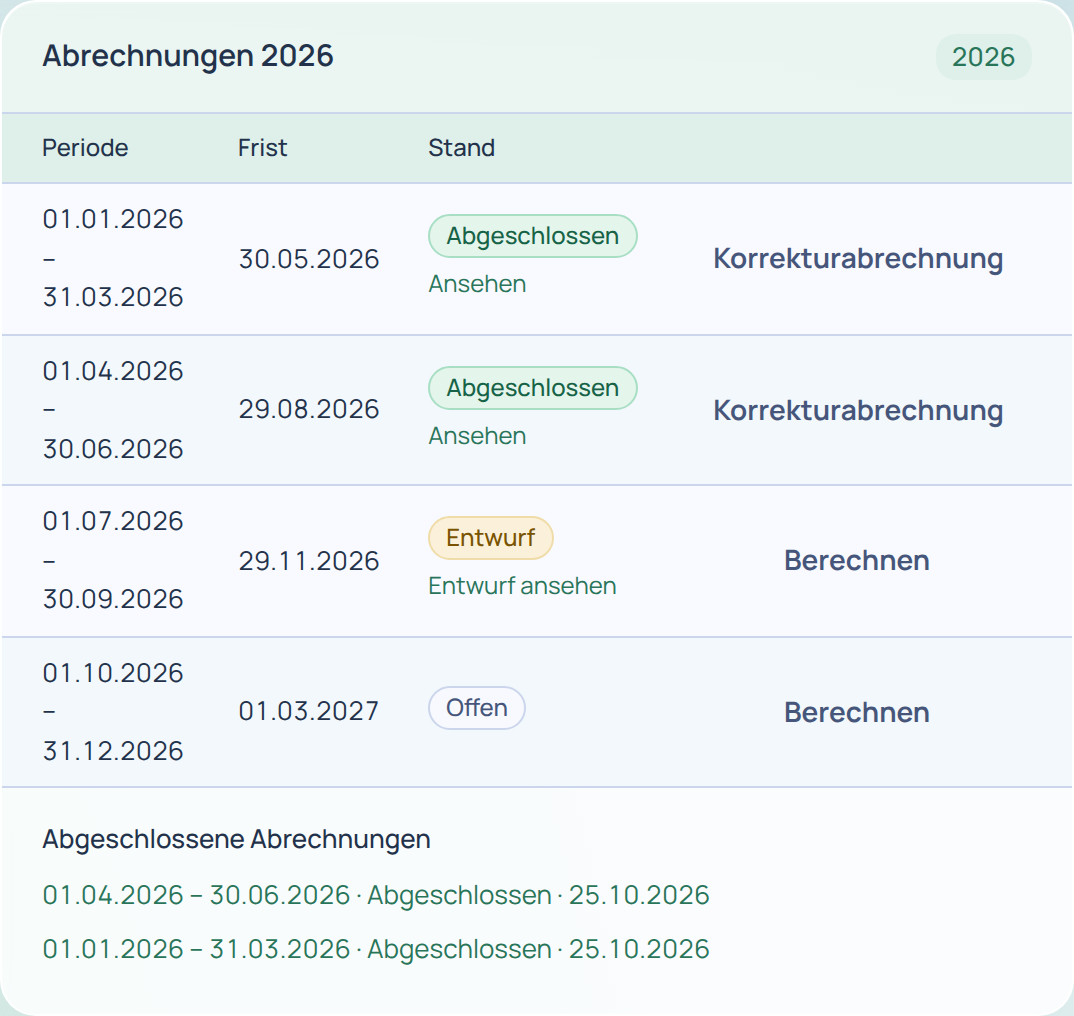
4. Add information and check. Enter values outside the accounts, such as subsequent input tax deduction, input tax corrections and reductions, subsidies and donations, directly in the return. Before closing, you see posted tax and the difference to the return.
5. Close and submit. On closing, Finance posts the balancing entry to the VAT settlement account and stores the XML file immutably in the voucher archive. Use eCH-0217 (XML) to download the return as an eCH-0217 file; the download is logged. Finance | base does not submit it; you submit it yourself in the FTA portal. The downloaded file currently conforms to eCH-0217 version 1.0, whereas the FTA portal requires version 2.0.0 for XML import. Import is therefore not guaranteed; until the changeover, transfer the values from the draft manually into the portal. Closing is possible only if the draft matches the current posting state. Open saved closings and corrections later through the VAT history for the relevant year.
What Finance | base does not cover: The FTA form “Annual reconciliation (amending return under Art. 72 VAT Act)” is not available in Finance | base. Correction returns cover corrections to individual periods; submit the annual reconciliation yourself in the FTA portal.
Try the demo or open a trial account. Swiss VAT return explains the return; Effective method or net tax rate? helps you choose, and Agreed or received consideration covers tax timing. Questions? Questions? See the Contact page.
Sources
- FTA: File VAT returns online (in German), accessed on 26.10.2026.
- Federal Act on Value Added Tax (VAT Act, MWSTG, SR 641.20), as at 1 January 2025: Art. 18, para. 2, Art. 25, Art. 26, Art. 27, Art. 28, Art. 29, Art. 30, Art. 31, Art. 33, Art. 42, Art. 71, Art. 72, Art. 80, Art. 87 and Art. 88, para. 1. fedlex.admin.ch (German original), accessed on 26.10.2026.
- Federal Tax Administration FTA: VAT correction return (in German) and Annual VAT reconciliation (amending return under Art. 72 VAT Act) (in German), accessed on 26.10.2026.
This guide does not replace legal or tax advice. Information as at 26 October 2026.