
Most businesses account for VAT using the effective method: they deduct the input tax they have paid from the tax due. Smaller businesses have an alternative, the net tax rate. Input tax is not calculated individually; instead, tax is calculated as a flat percentage of turnover. The VAT net tax rate can substantially reduce administration, but it is not cheaper for every business. This guide explains both methods, eligibility, rates and switching, and uses a worked example to show what matters when choosing.
Overview of the two methods
The law treats the effective reporting method as the general rule (Art. 36 of the Federal Act on Value Added Tax (VAT Act, MWSTG), para. 1). The tax claim is the difference between tax due and the input tax credit for the period (Art. 36, para. 2). You therefore need all purchase invoices showing tax and must allocate each input tax amount correctly; see Input tax deduction and VAT correction returns.
The net tax rate method (Art. 37 VAT Act (MWSTG)) dispenses with this individual calculation. The FTA sets sector-specific rates that already take the sector’s typical input tax ratio into account (Art. 37, para. 3). The law also provides for the flat tax rate method (Art. 37, para. 5); it is available to public bodies and related institutions, associations and foundations and is not covered here.
How the net tax rate works
The tax claim is calculated by multiplying the total taxable consideration generated during the reporting period, including tax, by the net tax rate approved by the FTA (Art. 37 VAT Act (MWSTG), para. 2). No further calculation is needed, and input tax is not determined.
Nothing changes for your customers: your invoices continue to show tax at the statutory rate, not the net tax rate. Reporting under this method is half-yearly (Art. 35 VAT Act (MWSTG), para. 1). Whether tax is reported with the invoice or only on payment depends on the accounting basis, which you choose independently of the method: Agreed or received consideration. Two special rules from the FTA ordinance: rates for manufacturing sectors apply only if materials are included in the price, and rates for trading sectors only to new goods (Art. 1, paras. 2 and 3 of the ordinance).
Who may use it
Under Art. 37 VAT Act (MWSTG), para. 1, the net tax rate method is available to those generating no more than CHF 5’024’000 annual turnover from taxable supplies and owing no more than CHF 108’000 tax over the same period, calculated at the applicable net tax rate. Both limits must be met (law as at 1 January 2025; the FTA gives the same figures on its website). The FTA calculates turnover including tax.
In the first year of tax liability and the year before switching from the effective method, the FTA applies stricter turnover limits depending on the rate:
| Applicable rate | Maximum annual turnover |
|---|---|
| 0.1 %, 0.6 %, 1.3 % or 2.1 % | CHF 5.024 million |
| 3.0 % | CHF 3.60 million |
| 3.7 % | CHF 2.92 million |
| 4.5 % | CHF 2.40 million |
| 5.3 % | CHF 2.04 million |
| 6.2 % | CHF 1.74 million |
| 6.8 % | CHF 1.59 million |
From 3.0 per cent, CHF 108’000 divided by the rate gives turnover corresponding to the tax limit. The table’s millions are rounded: CHF 2’920’000 × 3.7 % = CHF 108’040. Check both statutory limits using exact amounts.
Businesses cannot choose this method if, among other things, they use VAT group taxation under Art. 13 VAT Act (MWSTG), apply the postponed accounting procedure on imports, have their registered office abroad or generate more than 50 per cent of turnover with other companies under common management using the effective method (Art. 77 of the Value Added Tax Ordinance (MWSTV), para. 2; further cases are listed there).
Which rates apply
The rates appear in the annex to the “FTA Ordinance on Net Tax Rates by Sector and Activity” (SR 641.202.62). The FTA revised some of them on 1 January 2025. Examples from the list (as at 1 January 2025):
| Sector / activity | Rate |
|---|---|
| Architectural practice, including construction management | 6.2 % |
| Fiduciary firm | 6.2 % |
| IT: services, unless listed elsewhere | 6.2 % |
| Painting / wallpapering | 5.3 % |
| Electrical installation business | 4.5 % |
| Joinery | 3.7 % |
The rate approved for you by the FTA is always decisive. Rates can change; check the current list on the FTA website.
Several activities. If you carry out several activities, the prescribed rate is approved for each activity accounting for more than 10 per cent of turnover (Art. 86 MWSTV, para. 1). Since 2025, more than two rates are possible; the former 50-per-cent rule for ancillary activities no longer applies. Post income separately for each rate (Art. 84 MWSTV, para. 3).
Application, minimum duration and switching
- Application: You must apply to the FTA for the net tax rate method (Art. 37 VAT Act (MWSTG), para. 4). Apply for a switch in the reporting arrangements section of the FTA portal.
- Newly registered: Newly registered businesses notify the FTA within 60 days of receiving the VAT number (Art. 78 MWSTV, para. 1).
- Minimum duration: The method must be retained for at least one tax period (Art. 37, para. 4). Those choosing the effective method can switch to the net tax rate method only after three years at the earliest; switches always apply from the start of a tax period.
- Switching deadline: Notify the FTA no later than 60 days after the start of the tax period from which the change should apply. Late notifications are not approved (Art. 79 MWSTV, para. 1; FTA). This also applies to switching back (Art. 81 MWSTV, para. 1).
- Effective to net tax rate: The FTA approves the switch if neither limit was exceeded in the previous period. Previously deducted input tax must be repaid on the current value of goods and services at the time of the switch, declared in the last return before the switch (Art. 79 MWSTV, paras. 2 and 3; according to the FTA, in box 415).
- Net tax rate to effective: Tax on the current value at the time of the switch can be deducted as input tax in the first return afterwards (Art. 81 MWSTV, para. 4; according to the FTA, in box 410). Anyone exceeding one or both limits in three consecutive tax periods must switch to the effective method at the start of the following tax period (Art. 81 MWSTV, para. 3).
Practical example: Holzbau Sonnmatt GmbH
Holzbau Sonnmatt GmbH is a fictional joinery in Musterhausen with taxable annual turnover of CHF 1’000’000.00 excluding VAT, all at the standard rate of 8.1 per cent. Including tax, this is CHF 1’081’000.00. Tax due is CHF 81’000.00. Its possible net tax rate is 3.7 per cent (joinery).
The limits are met: turnover is below CHF 5’024’000, tax of CHF 39’997 is below CHF 108’000, and turnover also remains below the CHF 2.92 million maximum applicable to the 3.7 per cent rate in the year before a switch.
Net tax rate: 1’081’000.00 × 0.037 = CHF 39’997.00.
Effective method, scenario A (ordinary year): net materials purchases of CHF 400’000.00 produce input tax of CHF 32’400.00; other net operating expenses of CHF 80’000.00 produce CHF 6’480.00. Total input tax is CHF 38’880.00, and tax payable is 81’000.00 − 38’880.00 = CHF 42’120.00. The net tax rate is CHF 2’123.00 cheaper.
Scenario B (a year with a machine costing CHF 150’000.00 net): additional input tax of CHF 12’150.00 increases total input tax to CHF 51’030.00; tax payable is 81’000.00 − 51’030.00 = CHF 29’970.00. The effective method is now CHF 10’027.00 cheaper.
The comparison reverses once input tax exceeds CHF 41’003.00 (81’000.00 − 39’997.00). Compare the effective liability (output tax less deductible input tax) with gross turnover multiplied by the approved net tax rate. The lower tax burden determines the numerical comparison.
Decision guide and checklist
The following points reflect practical experience, not statutory requirements:
- Little input tax, a high share of own work and few investments tend to favour the net tax rate; it also saves administration.
- High investment, large supplier purchases or strongly fluctuating input tax tend to favour the effective method.
- Anyone wanting to switch back must observe the minimum duration and notification deadline.
Before applying, check:
- Turnover including tax and tax amount calculated at the rate are within the limits (including previous years)
- No exclusions under Art. 77 MWSTV, para. 2 apply
- All activities exceeding 10 per cent of turnover allocated to the appropriate rates
- Effective liability for the last three years compared with gross turnover × approved net tax rate
- Repayment of input tax on current value planned for the switch
- Notification to the FTA within 60 days after the start of the tax period
- Ability to post income separately per rate
How KMU | base helps
The screenshots show the interface in German; KMU | base is also available in French, Italian and English.
In Finance | base, set the method under Accounting › VAT, in VAT status from date. For each company, specify from a given date whether it is liable for VAT and enter the VAT number, method, accounting basis and period. The history remains visible; earlier entries apply to earlier periods.
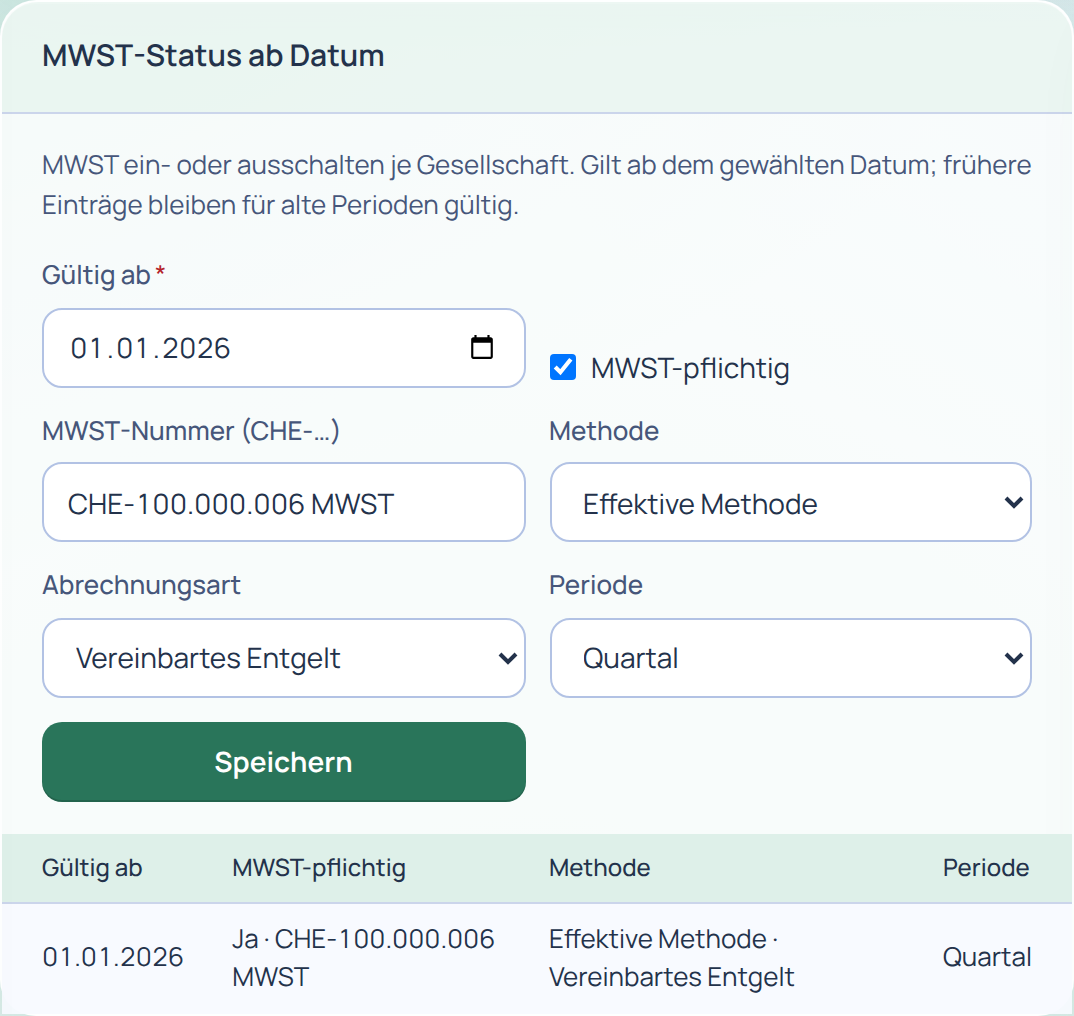
Effective or net tax rate. In Method, choose “Effective method” or “Net tax rate”. For the net tax rate method, enter up to two rates (Net tax rate 1 and Net tax rate 2, the second optional); these fields appear only for this method. On saving, Finance sets the period to half-yearly automatically. Enter the rate approved by the FTA. Application and approval still take place through the FTA portal. Finance | base calculates with up to two rates; since 2025 the FTA permits more.
Rates with validity dates. Each posting uses the statutory rate valid on its date (until 2023 and from 2024). However, the supply date determines the tax rate: check supplies spanning a rate change manually. For the second net tax rate from 2024, Finance generates box 332. Before submitting, manually allocate the values to the correct boxes using the current official FTA form. Add adjustments on changing method (boxes 415 and 410) directly to the return as Information outside the accounts; determine the amount yourself or with your fiduciary.

To try it yourself, view the demo or open a trial account. The Swiss VAT return guide explains the return itself; the Finance | base guides explain further steps. For questions, use our Contact page.
Sources
- Federal Act on Value Added Tax (VAT Act, MWSTG, SR 641.20), Art. 35, para. 1, Art. 36 and Art. 37, as at 1 January 2025: fedlex.admin.ch (German original), accessed on 26.10.2026.
- Value Added Tax Ordinance (MWSTV, SR 641.201), Art. 77, 78, 79, 81, 84 and 86, as at 1 January 2025: fedlex.admin.ch (German original), accessed on 26.10.2026.
- FTA Ordinance on Net Tax Rates by Sector and Activity (SR 641.202.62), Art. 1 and annex, as at 1 January 2025: fedlex.admin.ch (German original), accessed on 26.10.2026.
- FTA: Net tax rates and flat tax rates for VAT (in German) (eligibility, turnover limits in the first year, switching, boxes 410 and 415) and Net tax rates from 1 January 2025 (in German) (10-per-cent rule, 2025 changes), accessed on 26.10.2026.
- FTA: VAT Info 12 Net tax rates (in German), section 2.2.2 (deadline for switching to the net tax rate method) and section 3.2.2 (deadline for switching back), effective from 1.1.2025, accessed on 26.10.2026.
- FTA: Swiss VAT rates (in German) (standard rate 8.1 %), accessed on 26.10.2026.
This guide does not replace legal or tax advice. Information as at 26 October 2026.