
Anyone liable for VAT must know not only how much tax they owe, but also in which period. The accounting basis determines this. VAT has two bases: agreed consideration and received consideration. For the VAT cash basis, receipt of payment matters; for agreed consideration, it is the invoice. For an SME with late-paying customers, this can make a noticeable difference to liquidity. This guide explains both bases, the application process, switching and a worked example.
Overview of the two accounting bases
Art. 39 of the Federal Act on Value Added Tax (VAT Act, MWSTG) determines the timing of tax reporting. The principle: tax is reported on the basis of agreed consideration. This is the normal case and applies unless you have applied for something else. Reporting on received consideration is an exception permitted by the Federal Tax Administration (FTA) on application (Art. 39 VAT Act (MWSTG), paras. 1 and 2).
Consideration here means the amount your customer is to pay for your supply. It is “agreed” once you invoice it; it is “received” only when the money actually reaches you. The choice works in two directions: the tax you owe (output tax) and the tax you may deduct (input tax).
Agreed consideration: the rule
When reporting on agreed consideration, the right to deduct input tax arises when you receive the supplier’s invoice. Output tax liability arises (Art. 40 VAT Act (MWSTG), para. 1):
- On invoicing;
- For supplies leading to successive partial invoices or partial payments, when the partial invoice is issued or the partial payment is received;
- For advance payments for supplies not exempt from tax and supplies without invoicing, when consideration is received.
The tax claim belongs in the period in which it arises; likewise, limitation under Art. 42 VAT Act (MWSTG), para. 1 is linked to the tax period in which the claim arose. This has an unwelcome consequence: if you issue an invoice in March but the customer pays only in July, you must remit tax with the first-quarter return even though you have not yet received a franc.
Received consideration: only on application
When reporting on received consideration, output tax liability arises on receipt of the consideration. The right to deduct input tax arises on payment (Art. 40 VAT Act (MWSTG), para. 2). The invoice alone therefore triggers neither tax liability nor deduction. If the customer pays in instalments, tax arises with each payment for the portion received.
This basis reflects cash flows. It eases liquidity when customers pay late, but has a price: you may also deduct input tax on your own invoices only once you have paid them.
Comparison in a table
| Agreed consideration (rule) | Received consideration (on application) | |
|---|---|---|
| Output tax arises | On invoicing (exceptions: partial invoices, advance payments) | On receipt of payment |
| Right to input tax deduction arises | On receiving the supplier’s invoice | On paying the supplier’s invoice |
| Application required | No | Yes, to the FTA |
| Impact on liquidity | Tax is already due before the customer pays | Tax follows incoming cash |
| Commitment | At least one tax period after choosing | At least one tax period after choosing |
Application, minimum duration and mandatory switching
Application: Anyone wanting to report on received consideration needs FTA permission (Art. 39 VAT Act (MWSTG), para. 2). The FTA form is called “Application for reporting on the basis of received consideration” (no. 1100_01). Its forms page also refers to changing the accounting basis online in the FTA portal under “MWST abrechnen”, in the “Abrechnungsmodalitäten” tab (page as at 26 October 2026). The law does not specify the deadline or whether an informal application suffices; clarify this directly with the FTA.
Minimum duration: The chosen accounting basis must be retained for at least one tax period (Art. 39 VAT Act (MWSTG), para. 3). The tax period is the calendar year (Art. 34 VAT Act (MWSTG), para. 2). Switching back and forth within the year is therefore not permitted.
Mandatory switching: The FTA may require you to report on received consideration if you receive a substantial share of consideration before performing or invoicing the supply, or if there are reasonable grounds to suspect you are abusing reporting on agreed consideration to obtain an unlawful advantage for yourself or a third party (Art. 39 VAT Act (MWSTG), para. 4).
Changing the accounting basis
Two groups of items still outstanding at the time of the change are affected: customer receivables and supplier payables. For the effective method, the Value Added Tax Ordinance (MWSTV) sets out what applies in the reporting period after the change (Art. 106):
- Agreed to received: Deduct receivables outstanding at the time of the change from consideration received in that period because their tax has already been reported. Deduct input tax on existing payables from input tax paid.
- Received to agreed: Report tax on existing receivables and deduct input tax on existing payables.
Art. 107 MWSTV applies to net and flat tax rates. Because the change creates one-off special items in the return, it is worth speaking with your fiduciary before applying.
Practical example: Seeland Gartenbau GmbH
Seeland Gartenbau GmbH is a fictional business using the effective method, reporting quarterly and applying the standard rate of 8.1 per cent (Art. 25 VAT Act (MWSTG), para. 1). There are two transactions in the first half of 2026:
- Sale: Invoice dated 20 March 2026 to Gemeinde Seeblick for CHF 10’000.00 plus CHF 810.00 VAT, total CHF 10’810.00. The customer pays half (CHF 5’405.00) on 15 April 2026 and the remainder (CHF 5’405.00) on 10 July 2026.
- Purchase: Materials invoice dated 12 March 2026 for CHF 5’000.00 plus CHF 405.00 input tax, total CHF 5’405.00. The GmbH pays on 20 April 2026.
Checking the figures: 8.1 per cent of CHF 10’000.00 is CHF 810.00, and of CHF 5’000.00 is CHF 405.00. Each of the two payments covers half the invoice, so each contains CHF 405.00 tax. Tax arises in the individual quarters as follows:
| Quarter 2026 | Output tax, agreed | Input tax, agreed | Tax payable, agreed | Output tax, received | Input tax, received | Tax payable, received |
|---|---|---|---|---|---|---|
| 1st (Jan–Mar) | 810.00 | 405.00 | 405.00 | 0.00 | 0.00 | 0.00 |
| 2nd (Apr–Jun) | 0.00 | 0.00 | 0.00 | 405.00 | 405.00 | 0.00 |
| 3rd (Jul–Sep) | 0.00 | 0.00 | 0.00 | 405.00 | 0.00 | 405.00 |
| Total | 810.00 | 405.00 | 405.00 | 810.00 | 405.00 | 405.00 |
Across the three quarters, tax payable is the same in both cases: CHF 405.00. The difference is timing: on agreed consideration, Seeland Gartenbau GmbH must pay CHF 405.00 with the first-quarter return even though the customer has paid nothing by the end of that quarter; the first payment arrives only on 15 April, in the second quarter. On received consideration, nothing arises in the first quarter; in the second, output and input tax cancel each other out, and tax becomes payable in the third quarter when the remainder arrives. The return must be submitted within 60 days of the reporting period ending under Art. 71 VAT Act (MWSTG), para. 1.
Which accounting basis suits you?
The decision depends on your business. Three questions help:
- Do your customers regularly pay late? Received consideration then eases liquidity because you do not finance tax in advance.
- Do you receive many advance payments? Received consideration offers little benefit, because tax arises on receipt anyway (Art. 40 VAT Act (MWSTG), para. 1, let. c), and the FTA can require a change.
- How large are your purchases? If you invest heavily and pay invoices slowly, you also postpone input tax deduction.
For a binding assessment of your case, contact the FTA or your fiduciary. Whether switching to the net tax rate is worthwhile is covered in Effective method or net tax rate?; Swiss VAT return explains the structure of the return.
Checklist
- Current accounting basis known (rule: agreed consideration unless an application was made)
- Effect on output and input tax understood
- If received consideration is desired: applied to the FTA and waited for permission
- Minimum duration of one tax period (calendar year) observed
- Outstanding receivables and payables compiled at the changeover
- Date of every payment recorded accurately (decisive for received consideration)
- Partial payments taken into account proportionately
- Deposits and advance payments checked separately
- Correct VAT codes selected for every posting
- Reporting deadline of 60 days after period end entered in the calendar
How KMU | base helps
The screenshots show the interface in German; KMU | base is also available in French, Italian and English.
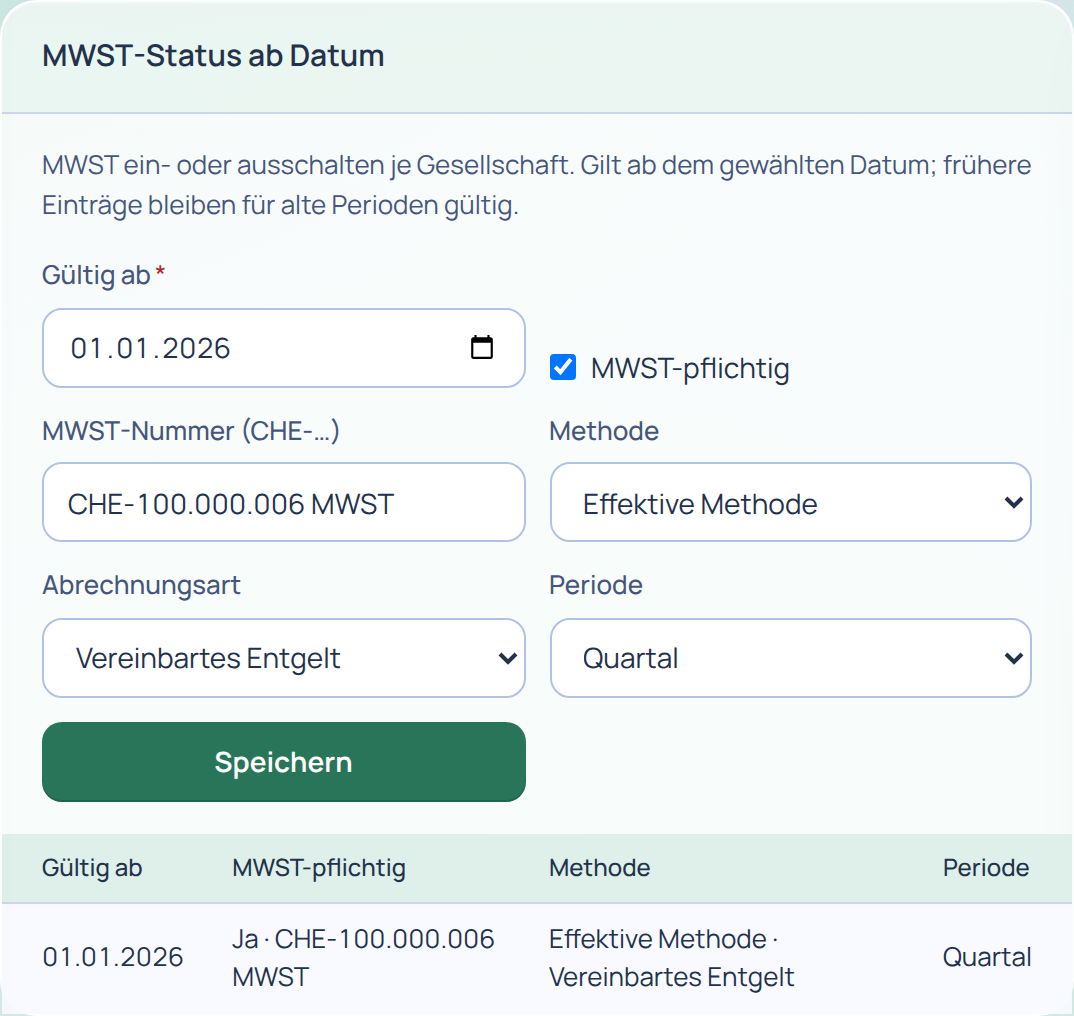
1. Set the accounting basis. In Finance, open VAT, then VAT status from date. For each company, specify from a given date whether it is liable for VAT, with VAT number, method, Basis of accounting (Agreed consideration or Received consideration) and period. The history remains visible; earlier entries continue to apply to old periods. Important: the setting in Finance | base does not replace an application to the FTA (Art. 39 VAT Act (MWSTG), para. 2). Enter received consideration only once permission has been granted.
2. What the choice does. On received consideration, invoices with open items count only on payment and proportionately; cash and bank postings count immediately. The date of the recorded payment is therefore decisive. Bank reconciliation with camt files explains how payments from bank files are matched to invoices.
3. Post correctly with VAT codes. In the Journal, enter a New entry with account, debit or credit, amount and VAT code per line. Available codes cover output tax (standard, reduced, accommodation, opted, exempt, abroad, notification procedure, excluded), input tax on materials and investments, acquisition tax and net tax rate. For a company liable for VAT, Finance automatically splits the gross amount by VAT code into base and tax on the configured VAT accounts; amounts on lines with a VAT code include VAT.
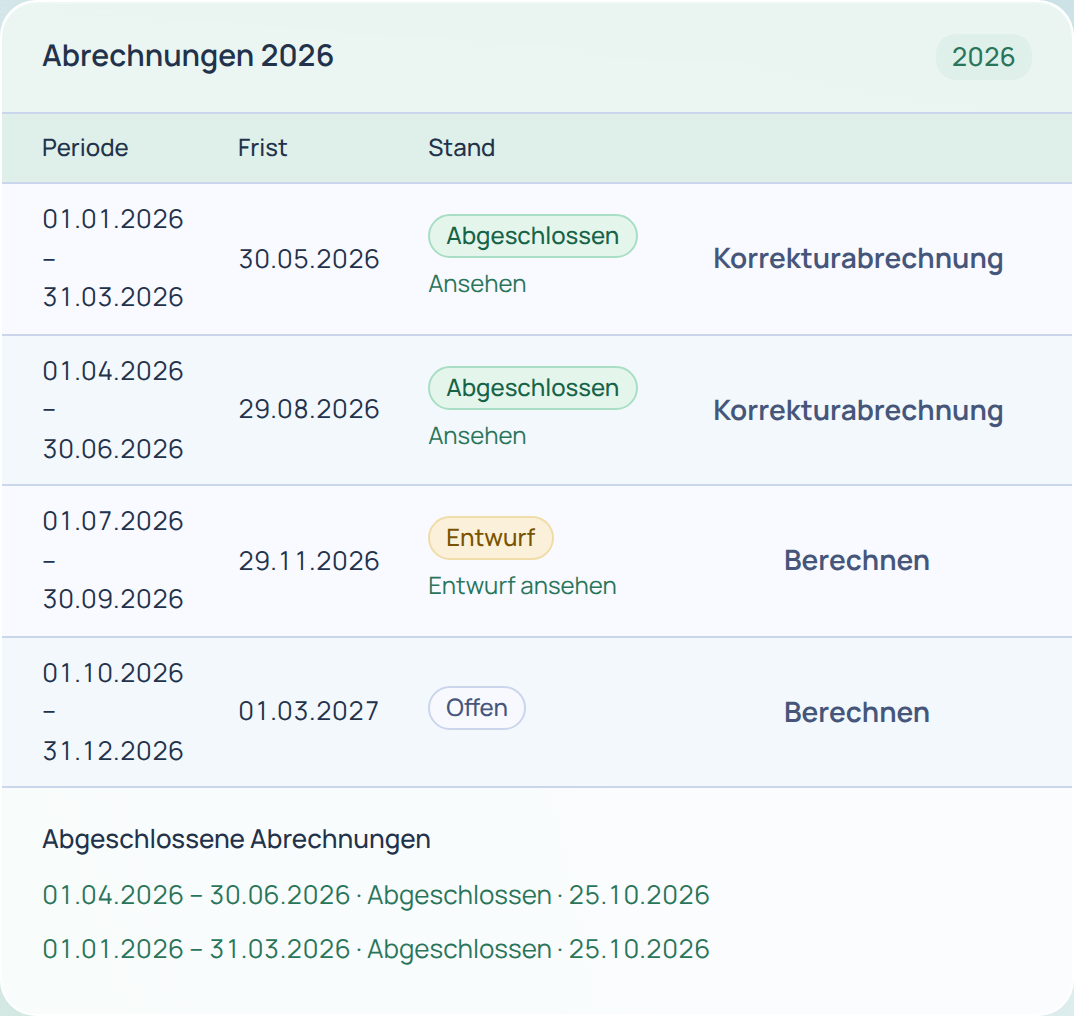
4. Monitor periods and deadlines. The VAT area’s period overview shows all periods for each year with status (open, draft, closed) and the 60-day deadline; overdue deadlines appear in red.
To try it yourself, view the demo or open a trial account. Further steps are in the Finance | base guide. For questions, use our Contact page.
Sources
- Federal Act on Value Added Tax (VAT Act, MWSTG, SR 641.20), Art. 25, para. 1, Art. 34, para. 2, Art. 35, Art. 39, Art. 40, Art. 42, para. 1 and Art. 71, para. 1, as at 1 January 2025: fedlex.admin.ch (German original), accessed on 26.10.2026.
- Value Added Tax Ordinance (MWSTV, SR 641.201), Art. 106 and 107, as at 1 January 2025: fedlex.admin.ch (German original), accessed on 26.10.2026.
- Federal Tax Administration FTA: VAT forms (in German), “Effective method” section, form 1100_01 “Application for reporting on the basis of received consideration”, accessed on 26.10.2026.
This guide does not replace legal or tax advice. Information as at 26 October 2026.