
Most SMEs seek fiduciary help for annual accounts, taxes or VAT. Working with fiduciaries succeeds through clear agreements: who records which documents, who may see/post what, and what the mandate covers. This guide explains law, task sharing and direct system access instead of exchanged folders/email attachments.
Who remains responsible
Bookkeeping/reporting duties fall on the business, not its fiduciary. Art. 957, para. 1 of the Code of Obligations (OR; CO) covers sole proprietorships/partnerships with at least CHF 500’000 prior-year revenue and legal entities. Management must ensure bookkeeping, though it may delegate work. See Bookkeeping obligations for SMEs.
For AGs, structuring accounting, financial control and necessary financial planning is a non-transferable, inalienable board duty (Art. 716a, para. 1, point 3). Prepare/submit annual reports for approval within six months of year-end; the highest management/administrative body’s chair and internal accounting responsible person sign (Art. 958, para. 3).
Our practical rule follows from these duties, although it is not itself statutory wording: you can outsource the work, but you cannot outsource the responsibility. The people signing the annual report need insight into its figures. A fiduciary can prepare the bookkeeping and statements, while responsibility for ensuring that the work is done remains with the business and its responsible bodies.
Mandate law briefly
Service contracts without another specific CO classification follow mandate law (Art. 394, para. 2). Fiduciary mandates usually qualify; your contract determines this. Key points:
- Scope: absent express definition, the transaction’s nature determines scope (Art. 396, para. 1). Avoid misunderstandings by writing what each party does.
- Instructions: deviation requires permission unless obtaining it is impracticable and consent can be assumed (Art. 397, para. 1).
- Care: mandatary liable for faithful, diligent performance (Art. 398, para. 2). Personal performance unless substitution authorised, required by circumstances or customarily permitted (para. 3).
- Accountability: account for management whenever requested (Art. 400, para. 1).
- Termination: either party may revoke/terminate anytime; untimely withdrawal requires compensation for resulting loss (Art. 404).
Practical task sharing
Negotiate responsibilities. Common practice, not law:
| Task | Often business | Often fiduciary |
|---|---|---|
| Invoice and monitor payments | Yes | Review |
| Capture/approve incoming invoices | Yes | Samples |
| Routine entries/bank reconciliation | Yes or shared | Review; entry if needed |
| Payroll | Yes or shared | According to mandate |
| VAT return | Review/approval | Preparation |
| Annual accounts | Approval/signature | Draft statements |
| Tax return | Provide documents | Preparation |
The important point is to agree who handles every row in this division of tasks. A short list of responsibilities and deadlines is enough to make the arrangement clear. See Swiss VAT returns.
Fiduciary and auditor
Can the bookkeeping firm also audit? Audit type determines this. AG rules apply correspondingly to GmbHs (Art. 818, para. 1 CO).
- Ordinary audit: required, among others, when two of these thresholds are exceeded in two consecutive years: CHF 20 million assets, CHF 40 million revenue, 250 average annual FTEs (Art. 727, para. 1, point 2). Bookkeeping participation/services risking self-review conflict with independence (Art. 728, para. 2, point 4).
- Limited audit: required where ordinary-audit criteria are absent (Art. 727a, para. 1). Auditor must be licensed under audit-oversight law (Art. 727c). Bookkeeping participation is permitted; self-review risk requires appropriate organisational/personnel safeguards for reliable auditing (Art. 729, para. 2). The report discloses participation where applicable (Art. 729b, para. 1, point 3).
- Opt-out: unanimous shareholders may waive limited audit with no more than ten average annual FTEs. Applies only to future years; register with the commercial registry before year-start (Art. 727a, para. 2).
Ask explicitly whether your fiduciary also acts as the company’s auditor, so that you can clarify which independence requirements apply to the arrangement.
Data protection: access rather than attachments
Accounts contain personal data: customer, supplier and employee names/addresses, payroll postings and payment details. Personal data concerns identified/identifiable natural persons (Art. 5(a) of the Federal Act on Data Protection (DSG)).
Contractual third-party processing falls under Art. 9: processing only as you could lawfully do, with no statutory/contractual secrecy prohibition (para. 1). Ensure the processor can guarantee data security (para. 2); subprocessors need your prior approval (para. 3). Controllers/processors both need appropriate technical/organisational security (Art. 8, para. 1).
Whether a fiduciary is a processor depends on tasks; clarify in the mandate. Direct system access is advice, not law: data stays together, rights remain under your control and access can end with the mandate.
Practical example: Seeblick Haustechnik AG
Fictional Seeblick Haustechnik AG uses calendar years; the fiduciary prepares closing. Access is “Read, post and export”, without closing: the board chair locks months. Mandate deadlines:
| Date | Who | Task |
|---|---|---|
| Fri 29.01.2027 | Seeblick | 2026 records entered; bank reconciled through 31.12.2026 |
| Fri 05.02.2027 | Both | Review pre-closing reconciliation and ten-entry sample |
| Fri 12.03.2027 | Fiduciary | Deliver draft statements |
| Fri 26.03.2027 | Board | Review draft; send statements to auditor |
| Fri 23.04.2027 | Auditor | Audit report available |
| Fri 14.05.2027 | Board | Adopt annual report for general meeting; invite |
| Thu 10.06.2027 | Board | Latest: reports accessible to shareholders |
| Wed 30.06.2027 | Shareholders | Latest: ordinary general meeting |
An external auditor, separate from the fiduciary, performs limited audit. AG law requires the meeting within six months (Art. 699, para. 2), here by 30 June 2027. Make annual/audit reports accessible at least 20 days before (Art. 699a, para. 1): 10 June. Audit reports must precede approval; absence renders approval/profit-allocation resolutions void (Art. 731, paras. 1, 3). Opting out under Art. 727a, para. 2 would remove auditor/report. On 5 February, three entries lack evidence; Seeblick supplies it by Friday, 12 February 2027.
Checklist
- Written mandate: scope, tasks, deadlines, contacts
- Routine-entry responsibility clear
- System access instead of emailed records; minimum necessary rights
- Third-party/subcontractor processing permissions clarified
- Mandate covers security, third parties and return of data
- Dual fiduciary/auditor role checked; separation arranged
- AG deadlines scheduled: reports accessible 20 days before meeting; meeting within six months
- Avoid fiduciary changes during closing (Art. 404: untimely termination)
- Deactivate user access when mandate ends
How KMU | base helps
The screenshots show the German interface; KMU | base is also available in French, Italian and English.
Fiduciaries work directly in Finance | base with their own access.
1. Invite. Finance › Settings › Finance settings, Fiduciary access, Invite accountant: enter email, first/last name, firm, companies and “Read only”, “Read, post and export” or “Read, post, export and close”. The dialogue creates a dedicated role without basic HR rights. Invitation requires Finance “Manage” and user-management rights. Resend failed invitations under Settings › Users and roles. Email must be unused: existing addresses fail, but “Please enter user and fiduciary firm.” does not explain why.
2. Rights. The “Fiduciary” role template grants read/post/export when assigning it through user management. The invitation dialogue instead uses its three levels. Accounting separates Read, Post (including Export), Close and Manage (chart, centres, VAT, fiduciary access), determining whether advisers observe, post or close.
3. No additional access charge. Marked fiduciary users do not count as Finance users or increase price; see Prices. Removing the marking leaves login active and counting as an ordinary user. End access by deactivating under Settings › Users and roles.
4. Reconciliation. Finance › Accounting › Closing checks year-end receivables/payables against control accounts, open VAT periods/incoming invoices/bank movements and unsupported entries. Both parties see the same fixed ten-entry annual sample. Differences do not block closing but need resolution. See Year-end checklist.
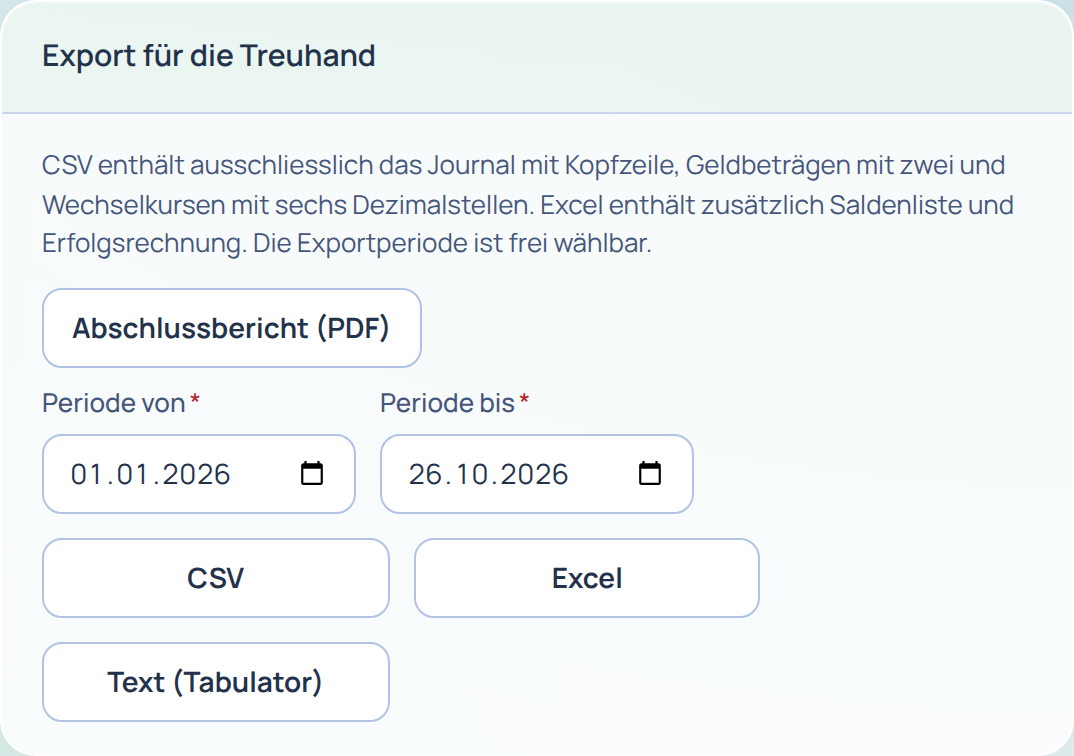
5. Export. Finance › Accounting › Reports, Export for the fiduciary, allows any period. CSV contains journal/header only, amounts two decimals, rates six; Excel adds trial balance/income statement; tab-separated text remains available. Every export is logged. Export rights are required and included in Post.
One limitation: no single fiduciary login across customer tenants. Each customer needs separate access and a separate email address because addresses are unique.
Try the Demo or open a test account. Questions? See the Contact page.
Sources
- Code of Obligations (OR, SR 220), Art. 394, para. 2; Art. 396, para. 1; Art. 397, para. 1; Art. 398, paras. 2–3; Art. 400, para. 1; Art. 404; Art. 699, para. 2; Art. 699a, para. 1; Art. 716a, para. 1, point 3; Art. 727, para. 1, point 2; Art. 727a, paras. 1–2; Art. 727c; Art. 728, para. 2, point 4; Art. 729, para. 2; Art. 729b, para. 1, point 3; Art. 731, paras. 1 and 3; Art. 818, para. 1; Art. 957, para. 1; Art. 958, para. 3, as at 1 October 2026: Fedlex (German original), accessed 26.10.2026.
- Federal Act on Data Protection (DSG, SR 235.1), Art. 5(a), Art. 8, para. 1 and Art. 9, version of 1 September 2023: Fedlex (German original), accessed 26.10.2026.
- Practical task sharing and system access reflect experience, not statutory rules.
This guide does not replace legal or tax advice. Information as at 26 October 2026.