
An invoice is overdue: time to write a payment reminder. Irregular reminders reduce liquidity and weaken evidence in disputes. This guide explains default, three practical reminder stages, reminder content, default interest, fees and debt enforcement.
When you may send reminders: due dates and default
You can only send a reminder once the claim is due. If neither the contract nor the nature of the legal relationship determines a time, performance can be demanded immediately under Art. 75 of the Code of Obligations (CO, OR). Usually, however, the due date appears in the quote, contract or invoice (for example “payable within 30 days”).
A debtor enters default in two ways:
- By reminder: Once an obligation is due, the creditor places the debtor in default by sending a reminder (Art. 102 CO, para. 1).
- By an agreed fixed date: If a specific performance date has been agreed, the debtor enters default when that day expires, without a reminder being needed (Art. 102 CO, para. 2).
The second route requires an agreement. Whether a date merely printed on an invoice qualifies as an agreed fixed date depends on what you and the customer agreed (contract, quote, general terms and conditions). To be sure, send a reminder.
The law leaves two points open: Art. 102 CO specifies neither a particular form for reminders nor a minimum number. Legally, one reminder is therefore sufficient. The three-stage sequence in this guide is established practice, not a statutory requirement; it gives customers an opportunity to respond and documents your approach. Send reminders in a way that lets you prove dispatch (email with a dispatch log, registered letter).
The consequences of default: damages and default interest
A debtor in default must pay damages for late performance and is also liable for accidental damage. They can escape this liability by proving that the default occurred without any fault on their part, or that the accidental damage would have affected the subject of performance even if performance had been timely (Art. 103 CO).
For monetary debts, default interest is the main issue:
- A debtor in default on a monetary debt owes default interest at 5 per cent per year, even if the contractual interest rate is lower (Art. 104 CO, para. 1).
- If the parties contractually agreed higher interest, it may also be charged during default (Art. 104 CO, para. 2).
- Between commercial parties, a higher rate may be charged for any period in which the usual bank discount rate at the place of payment exceeds 5 per cent (Art. 104 CO, para. 3).
Interest runs from the start of default, meaning from expiry of the agreed fixed date or the reminder. If your reminder sets a payment deadline, in cases of doubt calculate interest only from expiry of that deadline; the law does not expressly address this. Calculate it day by day on the outstanding amount; the reminder text need only state that default interest of 5 per cent per year is payable.
Three reminder stages with deadlines
The following sequence has proved useful in practice. The days are guidelines to adapt to your sector and customers:
| Stage | Timing (guideline) | Tone and content |
|---|---|---|
| Payment reminder | A few days after the due date | Friendly, assumes an oversight; states the invoice, amount and a new payment date |
| 1st formal reminder | Around 14 days after the payment reminder | Firmer; deadline, reference to default interest, optionally a reminder fee |
| 2nd formal reminder | Around 14 days after the 1st formal reminder | Final deadline; announces debt enforcement if payment is not made |
Even a friendly payment reminder should clearly request payment by a date. Give every stage a specific dated deadline (ten to fourteen days is usual), rather than “immediately”.
What a reminder should contain
A good reminder is brief, factual and clear. It contains:
- Sender, date and recipient with a complete address
- Invoice number, invoice date, due date and description of the supply
- The outstanding amount, or remaining balance after partial payments, in the invoice currency
- The new payment deadline with a date
- For the 1st and 2nd formal reminders: reference to default interest of 5 per cent per year and any reminder fee with its amount
- For the 2nd formal reminder: notice that the claim will be pursued through debt enforcement
- Payment details, preferably including the payment section again so payment can be made without typing errors
- A contact for queries and a statement that payment and reminder may have crossed
Avoid accusations: the reminder letter may later appear in debt enforcement or court proceedings.
Reminder fees
The Code of Obligations does not regulate reminder fees in Art. 102–104; it regulates damages (Art. 103) and default interest (Art. 104). Whether you may charge reminder fees, and how much, therefore depends on the agreement, usually the general terms and conditions. If your terms do not provide for reminder fees, it is better to forgo them. Otherwise, charge only the amount stated in the terms, and only from the 1st formal reminder onwards. There is no statutory amount: established practice, not a statutory requirement.
Checks before sending a reminder
An unjustified reminder damages the customer relationship. Check before every dispatch:
- Has payment arrived? Payments are often posted days later. Reconcile incoming bank payments first.
- Is there a complaint? Resolve it first.
- Is there an agreement? With an instalment agreement or payment deferral, do not use the standard reminder sequence.
- Are the address and amount correct? An incorrect address delays delivery and subsequent debt enforcement.
- Was the last reminder delivered? If it was returned, the reminder is hard to prove: correct the address and resend first.
When reminders do not help: debt enforcement and limitation
If the customer still does not pay after the final reminder, debt enforcement under the Federal Act on Debt Enforcement and Bankruptcy (SchKG) remains. The process in brief:
- Debt enforcement request to the debt enforcement office, in writing or orally. It names creditor and debtor, the claim amount and, for interest-bearing claims, the interest rate and date from which interest is claimed, as well as the debt instrument or basis of the claim (Art. 67 SchKG, para. 1).
- Debt enforcement costs: The debtor bears them; the creditor must advance them (Art. 68 SchKG, para. 1).
- Payment order: The debt enforcement office issues it upon receiving the request. It requires the debtor to pay within 20 days and notes that they may lodge an objection within ten days of service (Art. 69 SchKG, para. 2).
- Objection: The debtor declares it immediately to the person serving the payment order or to the debt enforcement office within ten days; no reasons are required (Art. 74 SchKG, para. 1 and Art. 75 SchKG, para. 1). Consult specialists for disputed claims.
Limitation: Claims generally become time-barred after ten years (Art. 127 CO). A five-year period applies, among other things, to claims for craft work, retail sales of goods, professional services of lawyers, legal agents, procurators and notaries, and employees’ claims arising from employment (Art. 128 CO, no. 3). The period starts when the claim falls due (Art. 130 CO, para. 1). Under Art. 135 CO, it is interrupted, among other things, by acknowledgement of the claim (including interest and part payments), debt enforcement, an application for conciliation or legal action; the provision does not list a mere reminder. Whether the shorter period applies to your claim depends on the individual case; assume it does if in doubt.
Practical example: Muster Gartenbau GmbH
Muster Gartenbau GmbH (fictional) issued an invoice for CHF 5’000.00 net on 3 June 2026. VAT at 8.1 per cent adds CHF 405.00, making the invoice total CHF 5’405.00. Payable within 30 days, it therefore falls due on 3 July 2026. The general terms provide for a CHF 20.00 fee for the 1st formal reminder. The settings are: payment reminder 7 days after the due date, 1st and 2nd formal reminders each 14 days after the previous one, and a 10-day deadline per reminder.
| Date | Step | Deadline |
|---|---|---|
| 3 July 2026 | Invoice due | |
| 10 July 2026 | Payment reminder (7 days after the due date) | By 20 July 2026 |
| 24 July 2026 | 1st formal reminder, 14 days after the payment reminder, with CHF 20.00 fee | By 3 August 2026 |
| 7 August 2026 | 2nd formal reminder if nothing has arrived by then | By 17 August 2026 |
The customer pays after the 1st formal reminder on 31 July 2026. In cases of doubt, Muster Gartenbau GmbH calculates default from expiry of the payment reminder deadline, meaning from 21 July (10 interest days, 21 to 30 July, with payment on 31 July): CHF 5’405.00 × 5 % × 10 / 365 = CHF 7.40 default interest. It receives CHF 5’405.00 invoice amount, CHF 20.00 fee and CHF 7.40 interest, totalling CHF 5’432.40. As no 2nd formal reminder was needed, there is no debt enforcement.
Checklist
- Due date checked, payment deadline passed
- Incoming payments reconciled, no partial payment overlooked
- No unresolved complaint, payment deferral or instalment agreement
- Invoice number, date, amount and new dated deadline stated
- Reference to default interest of 5 per cent per year (Art. 104 CO); interest calculated day by day once claimed
- Reminder fee only if provided for in the general terms
- Payment details enclosed (payment section or IBAN with reference)
- Dispatch can be proved (email with log or registered letter)
- After the 2nd formal reminder: debt enforcement request prepared
- Limitation periods monitored (Art. 127, 128 CO)
How KMU | base helps
The screenshots show the interface in German; KMU | base is also available in French, Italian and English.
In Finance | base, dunning follows your own deadlines. Here is the process.
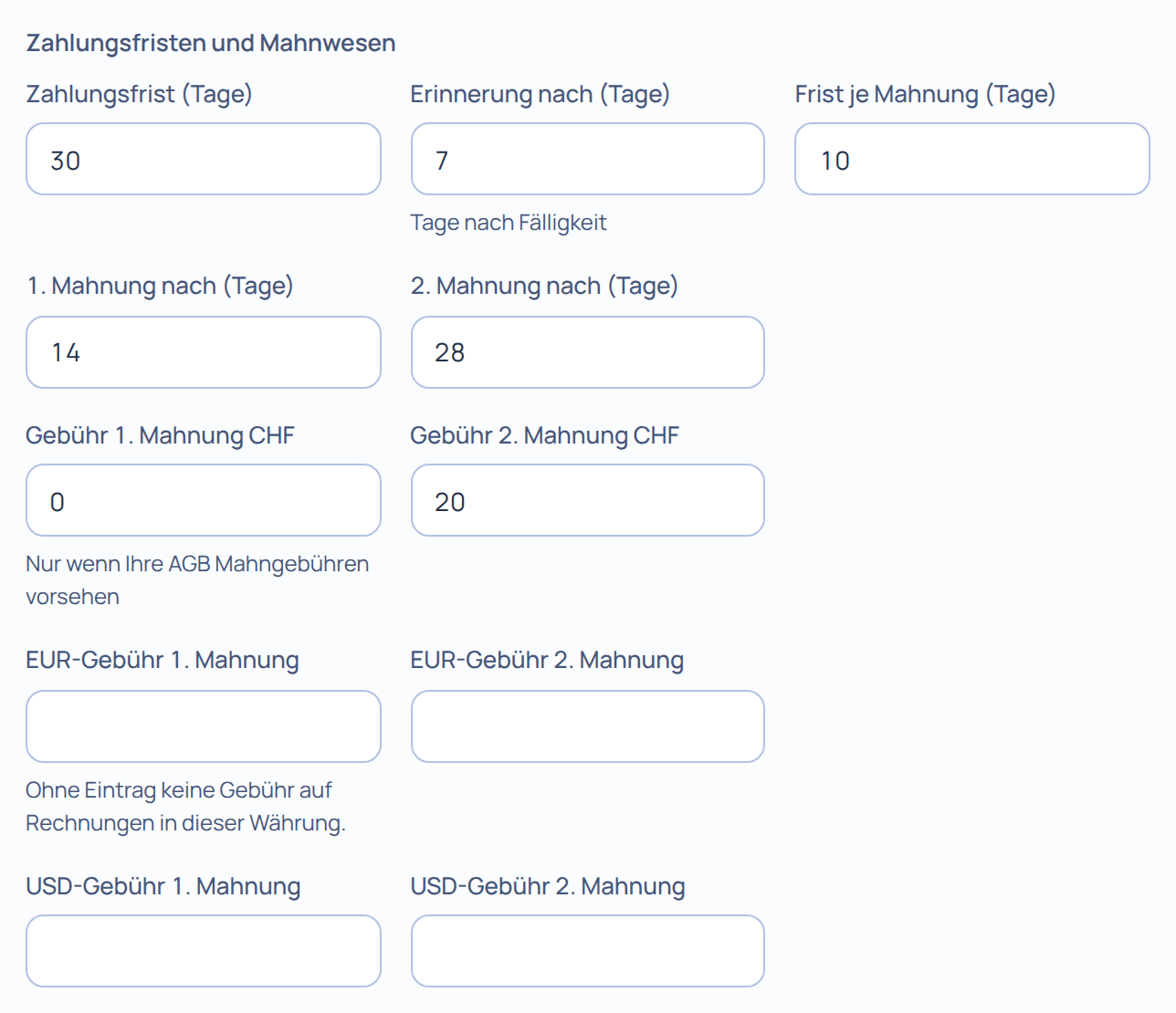
1. Set deadlines and fees. In Invoicing settings, the General tab contains the “Payment terms and dunning” group. Set “Payment terms (days)”, “Reminder after (days)” (days after due date), “1st notice after (days)”, “2nd notice after (days)”, “Deadline per notice (days)”, “Fee 1st notice CHF” and “Fee 2nd notice CHF”. The fee includes the note “Only if your terms provide for dunning fees”.
2. View the reminder list. In the Sales menu, open Dunning. The list shows all overdue invoices with their next possible stage. Send reminders individually or all at once (“dunning run”).
3. Check and send reminders. Payment reminders, 1st and 2nd formal reminders are created according to your deadlines, optionally with a fee, as PDFs by email. Before individual dispatch and before a dunning run, you see the stage, outstanding amount, additional fee, deadline and recipient. Tax note, terms, footer and transfer reference come from the issued document; the payment method determines the payment section. Write the email text yourself if needed: under Email texts, save your own texts for each occasion and language, including payment and formal reminders, with placeholders such as number, amount or due date.
4. Set a dunning block. Customers with a dunning block, for example because of an instalment agreement, receive no reminder suggestions. Set the block using the “Dunning block” checkbox in the customer form; these customers appear greyed out in the reminder list.
5. Track delivery. The dunning run shows separately how many reminders were created and how many were delivered. Every undelivered reminder appears in the dispatch log with a reason. Resend the same reminder or record that it was sent by post. The next stage follows only after delivery.
6. Match payments first. Upload the bank file (camt.053 or camt.054): payments with a QR or RF reference match the invoice automatically, while the rest await your allocation. This avoids reminders for invoices already paid. See Bank reconciliation with camt files.
Further guides: Create a QR-bill and Write a quote. Detailed operating instructions are in the Finance | base guide.
To try it yourself, view the demo or open a trial account. For questions, use our Contact page.
Sources
- Code of Obligations (CO, OR, SR 220), Art. 75, Art. 102, paras. 1 and 2, Art. 103, Art. 104, paras. 1–3, Art. 127, Art. 128, no. 3, Art. 130, para. 1 and Art. 135, as at 1 October 2026: fedlex.admin.ch (German original), accessed on 26.10.2026.
- Federal Act on Debt Enforcement and Bankruptcy (SchKG, SR 281.1), Art. 67, para. 1, Art. 68, para. 1, Art. 69, para. 2, Art. 74, para. 1 and Art. 75, para. 1, as at 1 January 2026: fedlex.admin.ch (German original), accessed on 26.10.2026.
This guide does not replace legal or tax advice. Information as at 26 October 2026.