
When you write a quote, you do more than state a price. A quote is generally a legally binding proposal: once the customer accepts, a contract exists. It is also your calling card in the sales process. This guide explains what a quote should contain, how long you are bound by it, how to distinguish fixed prices from estimates and how to make acceptance simple enough to turn an offer into an order.
What a quote means legally
A contract is concluded when the parties express matching intentions, either expressly or implicitly (Art. 1 of the Code of Obligations (CO, OR)). The quote is usually the offer within the meaning of Art. 3 et seq. CO: you offer a specific supply on specific terms. If the customer says yes, the contract is concluded. If the customer’s response differs from your quote, the corresponding mutual expression of intent under Art. 1 CO, para. 1 is missing to that extent; record the requested changes in a new quote and have it confirmed.
Whether a document qualifies as a binding offer depends on the individual case. Under Art. 7 CO, you are not bound if you attach a statement excluding binding effect (for example “non-binding quote”), or if such a reservation follows from the nature of the transaction or circumstances. Tariffs and price lists alone are not offers (Art. 7 CO, para. 2). You should therefore assume that an individually prepared quote addressed to a specific customer is binding.
For most contracts, the law prescribes no particular form (Art. 11 CO, para. 1); exceptions requiring one remain reserved. A quote by email is therefore generally possible. For evidence, however, a written quote and written or traceably logged acceptance are recommended.
How long you are bound
The binding period depends on whether you state a deadline:
| Situation | Legal position |
|---|---|
| Quote with an acceptance deadline (“valid until 4 November 2026”) | You are bound until the deadline expires; you are released if acceptance has not reached you before expiry (Art. 3 CO) |
| No deadline, to a person present (including by telephone) | If not accepted immediately, you are no longer bound (Art. 4 CO) |
| No deadline, to a person absent (letter, email) | You are bound until you can expect a reply sent properly and in good time to arrive (Art. 5 CO, para. 1) |
For the last case: you may assume that your quote arrived in good time. If acceptance sent in good time arrives later than expected and you do not wish to be bound, you must give notice without delay (Art. 5 CO, paras. 2 and 3). Whether a case concerns persons present or absent can be disputed in individual cases.
The practical conclusion is simple: always state a validity date. Both sides then know how long the offer lasts, and you need not rely on an undefined “reasonable” period. Thirty days is common but not legally required (established practice, not a statutory requirement).
If you notice an error after sending, revocation offers limited help: it is effective if it reaches the recipient before or together with the quote. If it arrives later, the recipient must become aware of the revocation before becoming aware of the quote (Art. 9 CO, para. 1). Check figures before sending.
What a quote should contain
The more complete the quote, the fewer issues remain later. Although a reservation concerning secondary terms is presumed not to prevent binding effect if all essential terms have been settled, a judge decides unresolved secondary terms according to the nature of the transaction in a dispute (Art. 2 CO). Do not leave matters to that. A good quote contains:
- Sender with full address, contact person, date and quote number
- Recipient with full address and the customer’s reference, if any
- A brief description of the task in the customer’s words
- Supplies and quantities listed separately, with unit and price
- A statement of whether prices include or exclude VAT, with tax rate and tax amount (the standard rate is 8.1 per cent, Art. 25 of the Federal Act on Value Added Tax (VAT Act, MWSTG), para. 1)
- Performance date or delivery period
- Payment terms, for example payment deadline or advance payment
- The validity date
- Acceptance method: how the customer accepts (signature, email, online acceptance)
- Reference to your general terms and conditions, if used
Fixed price, estimate or time-and-materials billing
For orders involving the creation of a work (such as refurbishment or installation), the law refers to a contract for work and services: the contractor undertakes to produce a work and the customer to pay remuneration (Art. 363 CO). The following pricing rules then apply:
- Fixed price: If remuneration was precisely determined in advance, the contractor cannot demand an increase even if more work was required than expected. If extraordinary circumstances prevent or excessively hinder completion, a judge may allow a price increase or termination where those circumstances were unforeseeable or excluded by the assumptions shared by both parties. Conversely, the customer must pay the full price even if the work requires less effort (Art. 373 CO).
- Estimate or no price agreement: If the price was not determined in advance or only approximately, it is based on the value of the work and the contractor’s expenses (Art. 374 CO).
- Exceeding an approximate estimate: If an agreed approximate estimate is disproportionately exceeded without the customer’s involvement, the customer may withdraw from the contract (Art. 375 CO, para. 1). For construction on the customer’s own land, the customer may instead demand a reasonable price reduction or, if unfinished, withdraw the continuation from the contractor and terminate against equitable compensation for work already performed (para. 2).
Therefore clearly mark each item in the quote as fixed price or estimated, billed on a time-and-materials basis. Inform the customer early if an estimate is likely to be significantly exceeded. Different provisions apply to sales or service contracts; the rules above concern contracts for work and services.
Structure and tone
Start with the benefit to the customer: what will the supply achieve, by when and at what price? Then give the details. Be specific (“12 LED lights, installation included”) rather than general (“lighting billed by time spent”). State the next steps at the end (“To accept, simply reply to this email or accept online by 4 November 2026”). Follow up: a quote without a response is not yet an order. Call after a few days or write briefly to ask whether there are any outstanding questions.
Practical example: Muster Elektro AG
Muster Elektro AG (fictional) prepares a quote on 5 October 2026 for the office fit-out of Beispiel Treuhand AG (also fictional). Valid until 4 November 2026, meaning 30 days:
| Item | Description | Quantity | Price | Amount CHF |
|---|---|---|---|---|
| 1 | Office electrical installation, electrician’s labour, estimated, billed on a time-and-materials basis | 48 h | 96.00 | 4’608.00 |
| 2 | LED panel light, fixed price | 12 pcs | 142.50 | 1’710.00 |
| 3 | Distribution box including materials, fixed price | 1 pc | 1’380.00 | 1’380.00 |
The items total CHF 7’698.00 excluding VAT. VAT at 8.1 per cent adds CHF 623.54. Total CHF 8’321.54. Item 1 is marked as estimated; items 2 and 3 are fixed prices. Beispiel Treuhand AG accepts online on 16 October 2026. Muster Elektro AG converts the quote into an order and schedules the work.
Step by step: from enquiry to order
- Clarify the enquiry. Exactly what is to be delivered, by when and to what specifications?
- Calculate the items. Quantity, unit, price; mark each item as fixed price or estimated.
- Structure the quote. Sender, recipient, description, items, tax, terms.
- Set validity. A clear date so that binding effect ends under Art. 3 CO.
- Check the preview. Check figures, address and wording before sending.
- Send and follow up. By email as a PDF or with an online link; follow up briefly after a few days.
- Record acceptance. Who accepted, and when? Acceptance belongs with the document.
- Continue the process. The accepted quote becomes an order, then an invoice.
Checklist
- Recipient and sender with full addresses
- Supplies listed individually with quantity, unit and price
- Each item marked as fixed price or estimated (time-and-materials billing)
- Prices shown including or excluding VAT, tax rate stated
- Performance date or delivery period stated
- Payment terms stated
- Validity date set (Art. 3 CO)
- Acceptance method described
- Figures recalculated before sending
- Follow-up scheduled
- Acceptance recorded with name and date
How KMU | base helps
The screenshots show the interface in German; KMU | base is also available in French, Italian and English.
In Finance | base, the quote is created as a document you can continue using without retyping. Here is the process.
1. Enter a quote. In the Sales menu, open Quotes and choose “New quote”. Create quotes with a validity date; leave “Valid until” empty to use the validity period from the settings. Expired quotes automatically receive “expired” status. Enter and sort items, headings, text lines, subtotals and page breaks in the document; net, VAT and total remain visible as you work.
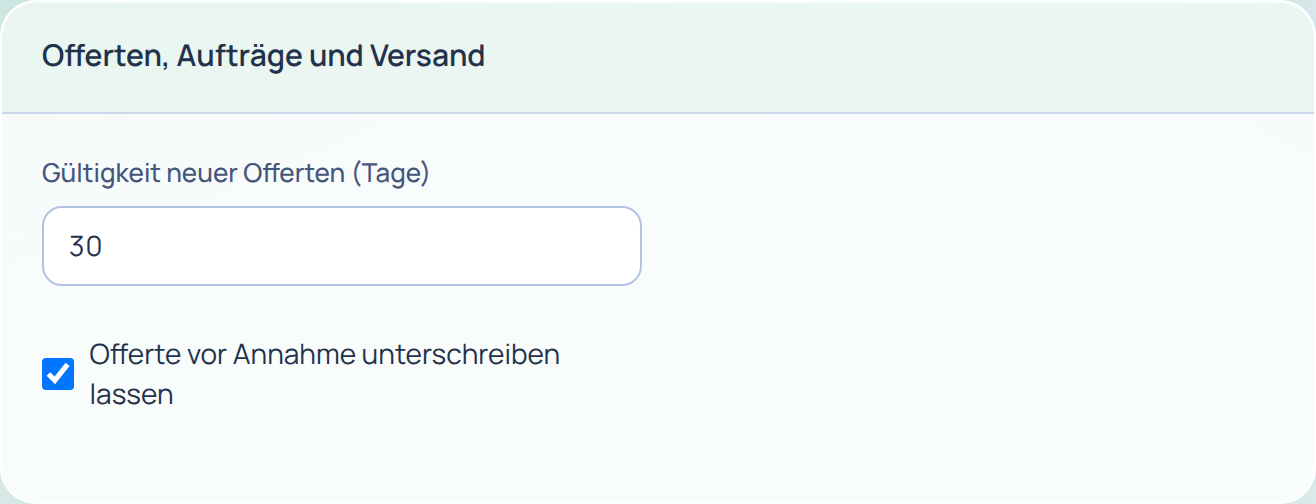
2. Texts and preview. Save header and footer texts per document type in four languages in the template and view a sample PDF (“Default texts by document type and language”). Before issuing, check the draft as a PDF preview before finalising it. Set quote validity in Invoicing settings, under “Quotes, orders and sending”.
3. Send. Send the issued quote using the document actions. Depending on the settings, the responsible person receives a notification when the customer views the document or accepts or declines the quote.
4. Acceptance. Your customer accepts the quote in the portal, optionally signing with mouse, stylus or finger, or declines it with a reason (“Accept quote online”). If acceptance came by telephone or email, record the customer’s acceptance with their name or rejection with a reason on the document (“Accept or decline quote (internal)”).
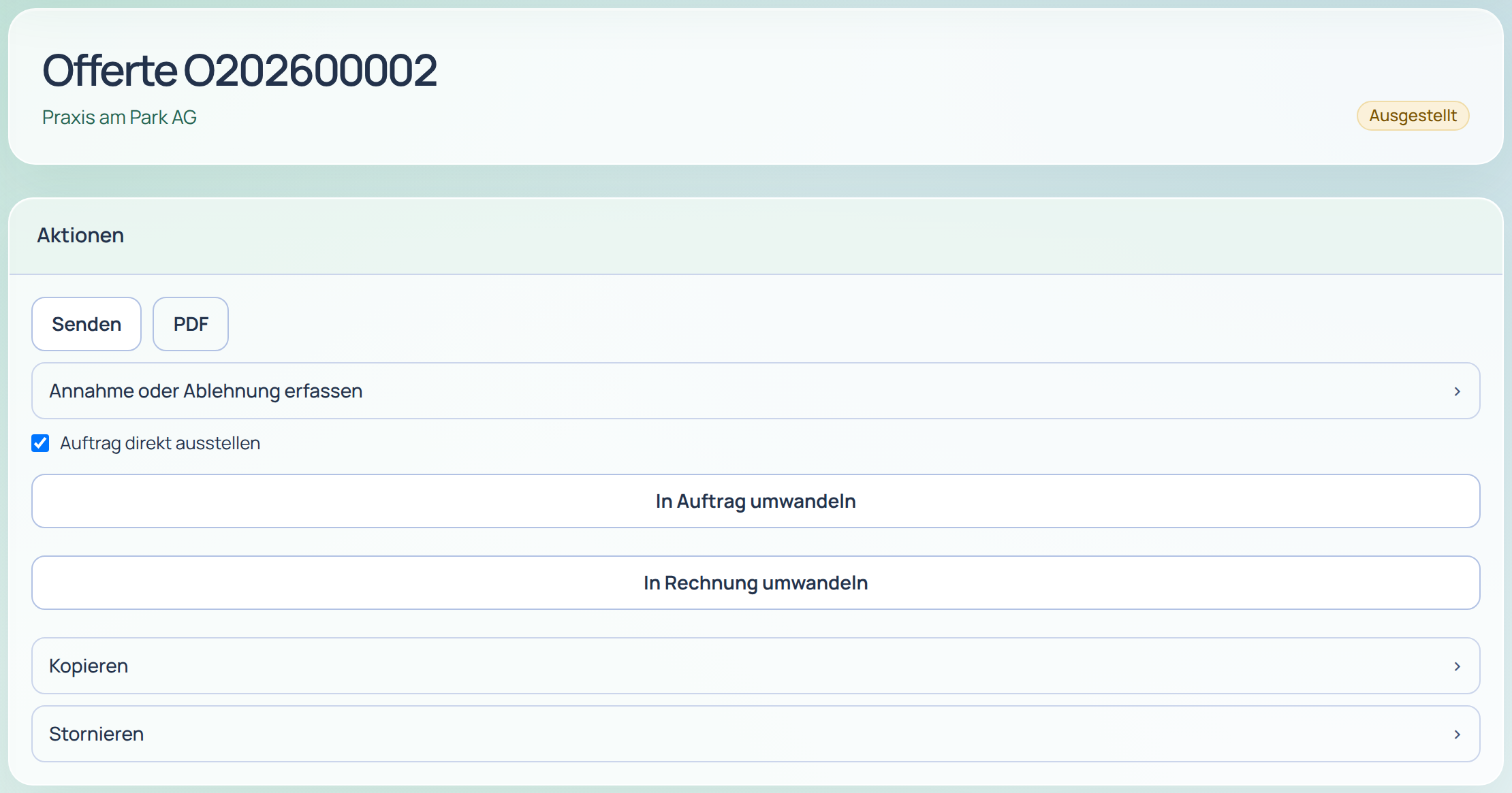
5. Continue the process. Turn the quote into an order or invoice without retyping (“Convert along the document chain”). Items and prices thus remain identical to what the customer accepted.
Further guides: Create a QR-bill and Write a payment reminder. Detailed operating instructions are in the Finance | base guide.
To try it yourself, view the demo or open a trial account. For questions, use our Contact page.
Sources
- Code of Obligations (CO, OR, SR 220), Art. 1, 2, 3, 4, 5, 7, 9, para. 1, Art. 11, para. 1, Art. 363, Art. 373, 374 and Art. 375, paras. 1–2, as at 1 October 2026: fedlex.admin.ch (German original), accessed on 26.10.2026.
- Federal Act on Value Added Tax (VAT Act, MWSTG, SR 641.20), Art. 25, para. 1, as at 1 January 2025: fedlex.admin.ch (German original), accessed on 26.10.2026.
This guide does not replace legal or tax advice. Information as at 26 October 2026.