
Working beyond agreed hours is overtime; beyond the statutory maximum, excess hours. Overtime and excess hours are often confused but follow different laws, supplements, compensation and limits. This guide explains Art. 321c of the Code of Obligations (OR; CO), Art. 9, 12 and 13 of the Labour Act (ArG), the 25 per cent supplement and time off in lieu.
Two terms, two laws
Overtime exceeds agreed, customary or standard/collective-contract hours (Art. 321c, para. 1 CO): a contractual issue. Forty-four hours against a 42-hour contract produces two overtime hours below the statutory maximum.
Excess hours exceed weekly statutory maxima (Art. 9, para. 1 ArG):
- 45 for industrial employees, office, technical/other staff, including large retail-business sales staff;
- 50 for everyone else.
Office/other first-group staff instead fall under 50 when working in the same business/unit alongside employees with a longer maximum (Art. 9, para. 5).
Exceptions include higher managerial functions (Art. 3(d)). Check coverage first. Statutory maxima are fixed, not prorated for part-time: excess hours begin only above 45/50 weekly.
SECO guidance explains that work beyond the weekly maximum after contractual overtime becomes excess hours. Thus excess hours usually also exceed contractual hours; not all overtime is excess hours. Flexitime within regulations is commonly not treated as overtime: practical distinction, governed by your agreement.
Contractual overtime under Art. 321c CO
Three questions:
- Duty to work overtime (para. 1): where overtime is necessary, the employee must perform it to the extent that they are capable of doing so and can reasonably be expected to do so in good faith.
- Compensation with time off (para. 2): with the employee’s agreement, the employer may compensate overtime within a reasonable period by granting at least an equal amount of time off.
- Wages and supplement (para. 3): where overtime is not compensated with time off, normal wages plus a supplement of at least one quarter, or 25 per cent, are payable unless a written agreement, standard employment contract or collective agreement provides otherwise.
For contractual overtime, the supplement is therefore the default rule, and a written agreement may provide a different arrangement. Ask your legal advisers to assess whether a particular clause is valid in the individual case. See Employment contracts.
Excess hours under labour law
Art. 12, para. 1 ArG permits excess hours exceptionally:
- urgent work or extraordinary workload;
- inventories, closing accounts and liquidation;
- preventing/remedying operational disruption where other measures cannot reasonably be expected.
Timing: Art. 25, para. 1 of Ordinance 1 to the Labour Act (ArGV 1) restricts urgency/workload, inventory, closing and liquidation excess work to daytime/evening and working days, subject to Art. 26 exceptions.
Limits: excess hours may not exceed two hours per employee per day, except on otherwise work-free days from Monday to Saturday, or in emergencies. The calendar-year total must not exceed 170 hours for employees subject to a 45-hour weekly maximum, or 140 hours for those subject to a 50-hour maximum (Art. 12, para. 2). According to the guidance, granting compensatory time off during the year does not reduce the cumulative number of excess hours already worked.
Supplement/time off (Art. 13):
- Para. 1 requires at least 25 per cent; office, technical/other staff and large-retail sales staff only for hours above 60 annually.
- Para. 2 removes the supplement if individual employees agree equal time off within a reasonable period.
Under Art. 25, para. 2 ArGV 1, compensatory time off must be taken within 14 weeks. A longer period may be agreed, but that agreed period must not exceed twelve months. These timing rules concern compensation for excess hours under labour law. For time-based pay, calculate the wage supplement using the hourly wage, excluding location, household and child allowances (Art. 33, para. 1).
The guidance treats the wage supplement for excess hours as mandatory, so an agreement simply excluding it is invalid. For office staff, this mandatory supplement applies only to excess hours above 60 in the calendar year. An employer may nevertheless also remunerate the first 60 hours. This differs from the written variations possible for contractual overtime under the Code of Obligations.
Supplement comparison
| Overtime | Excess hours | |
|---|---|---|
| Legal basis | Art. 321c CO | Art. 9, 12, 13 ArG |
| Threshold | Contractual hours | 45/50 weekly |
| Supplement | At least 25%, unless written or standard/collective-contract variation | At least 25%; office staff only above 60 annually; cannot exclude |
| Time off | Agreement, at least equal duration, reasonable period | Agreement, equal duration, normally within 14 weeks |
| Maximum | None in CO | 2 daily; 170/140 annually |
Practical example: Muster Treuhand AG
Fictional Muster Treuhand AG employs Ms Keller full-time in its office: 42-hour contract, statutory maximum 45, hourly pay CHF 40.00. In Monday, 16–Sunday, 22 March 2026, accounts closing justifies excess work (Art. 12, para. 1(b)). Monday–Thursday ten hours daily, Friday eight: 48 hours.
| Item | Hours |
|---|---|
| Worked | 48 |
| Contract | 42 |
| Total overtime (48 − 42) | 6 |
| Up to statutory maximum (45 − 42) | 3 |
| Excess hours (48 − 45) | 3 |
Option 1, time off: Keller agrees six hours off for six worked; no supplement. Three excess hours have a 14-week deadline. Counting from Sunday, 22 March gives Sunday, 28 June 2026. The Ordinance does not specify the starting point; calculate cautiously.
Option 2, payment, no variation: six hours paid with Art. 321c, para. 3 supplement: 6 × CHF 40.00 = CHF 240.00 plus CHF 60.00 (25%), total CHF 300.00. Supplement on the three excess hours arises from CO, not ArG: these are the first excess hours, below office staff’s annual 60 threshold.
Option 3, written exclusion: excluding contractual overtime supplement gives CHF 240.00 for six hours. ArG still governs excess hours. If 58 already worked by mid-December and five more arise, three (63 − 60) exceed the threshold and mandatorily earn 3 × CHF 40.00 × 0.25 = CHF 30.00.
Checklist
- ArG coverage and 45/50-hour maximum established
- Contract defines time off/pay and supplement
- Excess work justified under Art. 12, para. 1
- Daily/annual maxima monitored: 2, 170/140
- Time off by agreement; 14-week excess-hours deadline
- Office annual hours counted against 60 threshold
- Supplement excludes location, household and child allowances
How KMU | base helps
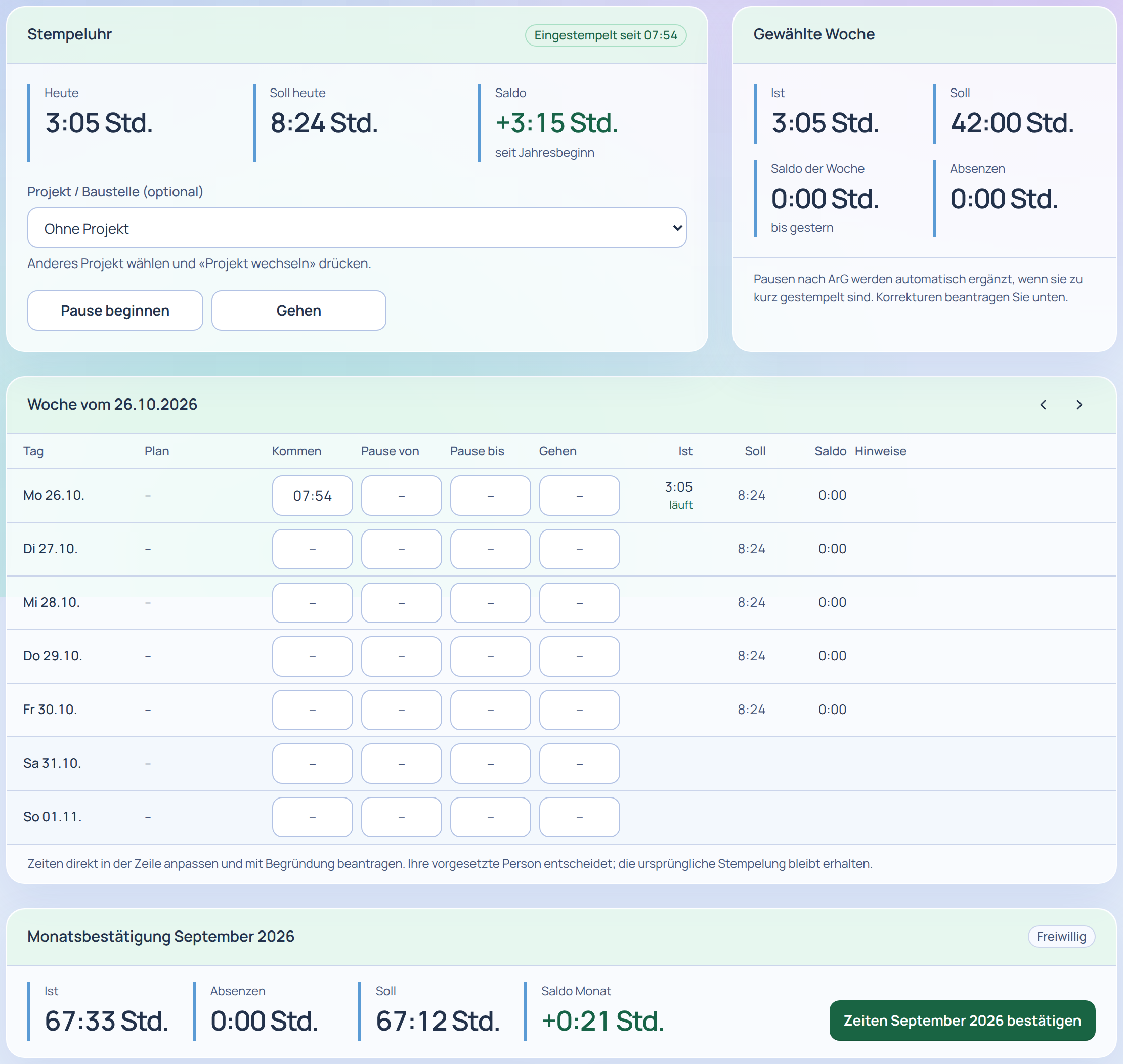
The screenshots show the German interface; KMU | base is also available in French, Italian and English.
HR | base distinguishes actual work beyond the statutory maximum as excess hours, and extra target hours up to that maximum as overtime.
1. Balances. Time › Time recording (My time) shows actual, target and balance daily, weekly, monthly and year-to-date, crediting absences/public holidays.
2. Overtime account. Per working-time model, Time › Time recording › Rules and models › Extra time and overtime sends accepted extra time to flexitime without premium or a separate overtime account. Pay through payroll transfer using the model premium, default 25%, optionally 0%, or compensate time with an adjustable factor. Post in Personnel › Employees, tab Access and clocking. Everything is logged; match premiums to contract.
3. Weekly excess hours. Model Maximum working time (ArG), 45/50 hours, produces separate excess-hours totals for complete calendar weeks, retained at time approval. View Time › Time recording › Working hours, “Excess hours ArG”, or Time approval, “Excess hours”.
4. Request time off. Flexitime compensation requests under Time › Absences can be full-day, half-day or hourly. They debit balance instead of being paid. Applicants see balance; approvers decide if insufficient. HR compensates overtime-account hours in the personnel file (step 2).
Unsupported: no office 60-hour threshold calculation, annual 170/140-hour check, or 14-week compensation monitoring/display. Every weekly excess hour transfers under ueberzeit_25, 25 per cent, even below 60. Additional overtime-account payments transfer under ueberstunden_auszahlung and ueberstunden_zuschlag without reconciliation against excess hours. Option 2 could therefore report supplements twice for the same hours. Review payroll lines before every run and agree applicability/thresholds with payroll accounting. The product does not assess the law for you.
Try the Demo or open a test account. See Working time recording duties. Questions? See the Contact page.
Sources
- Code of Obligations (OR, SR 220), Art. 321c, as at 1 October 2026: Fedlex (German original), accessed 26.10.2026.
- Federal Act on Work in Industry, Trade and Commerce (Labour Act, ArG, SR 822.11), Art. 3, 9, 12 and 13, as at 1 September 2023: Fedlex (German original), accessed 26.10.2026.
- Ordinance 1 to the Labour Act (ArGV 1, SR 822.111), Art. 25, para. 2 and Art. 33, para. 1, as at 1 September 2024: Fedlex (German original), accessed 26.10.2026.
- SECO: Guidance on the Labour Act and Ordinances 1 and 2 (in German), February 2026 edition, Art. 12/13 explanations as at November 2006, accessed 26.10.2026. Guidance expresses SECO’s interpretation, not a source of law.
This guide does not replace legal or tax advice. Information as at 26 October 2026.