Working time recording is normally mandatory for Swiss employers, not merely recommended. Labour law offers two narrowly defined concessions: waiver and simplified recording. This guide explains Art. 46 of the Labour Act (ArG) and Art. 73–73b of Ordinance 1 to the Labour Act (ArGV 1): required information, eligibility and daily compliance.
What law requires
Art. 46 ArG requires employers to make registers/records containing information needed to enforce the Act/ordinances available to enforcement/supervisory authorities. For personal data, it refers to the Data Protection Act of 25 September 2020.
Art. 1 generally covers public/private businesses, subject to business/person exceptions in Art. 2–3. Office/service SMEs should particularly note Art. 3(d): employees exercising higher managerial functions are excluded. Art. 9 ArGV 1 defines these through position, responsibility and business size: extensive decision powers or major influence on consequential decisions, sustainably affecting structure, operations and development of all/part of the business. Actual authority matters, not job titles.
Health-protection provisions still apply (Art. 3a ArG). “Trust-based working time” appears in neither Act nor Ordinance. Employees using it who are covered must still follow working-time rules.
Required records
Art. 73, para. 1 ArGV 1 sets out the information the records must contain. The list is expressly non-exhaustive. Its central requirements include:
- the daily and weekly hours actually worked, including compensatory work and excess hours, together with when that work took place (c);
- the weekly rest days or substitute rest days granted, insofar as they do not regularly fall on a Sunday (d);
- the timing and duration of breaks lasting half an hour or more (e);
- the pay supplements and additional time off owed under the law (h).
Recording a total number of hours is therefore not enough under the normal recording rules. The records also need to show when the work occurred. This makes it possible to check whether requirements such as the eleven-hour daily rest period under Art. 15a ArG were respected.
Keep the registers and records for at least five years after their validity expires (Art. 73, para. 2). SECO’s guidance clarifies that the period starts when the respective validity ends. As a practical precaution, retain a year’s records until the end of the fifth following year. This year-end approach is our practical advice, rather than a separate statutory retention rule.
Permitted recording methods
SECO’s methods guidance does not always require a time clock. Records must show when each person worked, took breaks and finished. Examples:
- handwritten calendars, reports or tables;
- electronic software, including smartphones;
- deriving time from IT login/building access if employees know, data has no other use and manual additions remain possible;
- fixed-time models/shift plans with every individual deviation additionally recorded, including extra hours and shifted breaks. Absences alone do not suffice.
According to SECO’s guidance, using flexitime or annualised working hours does not remove the duty to record the time each person actually works. The working-time model alone therefore does not replace the individual records.
Waiver (Art. 73a)
Art. 73a allows omission of Art. 73, para. 1(c), (d), (e), (h): time, rest days, breaks and supplements, only with all conditions:
- Collective employment agreement: social partners must agree; employers cannot decide alone. A majority of representative employee organisations must sign. Include special health/rest measures and an internal working-time contact point (para. 4).
- High autonomy: employees have a high degree of autonomy in their work and can largely determine their own working hours (para. 1(a)).
- Gross annual income including bonuses exceeds CHF 120’000, prorated for part-time (para. 1(b), effective 1 January 2016). Para. 2 adjusts the amount with the Accident Insurance Act maximum insured salary.
- Individual written waiver (para. 1(c)), revocable annually by either side (para. 3).
Keep the collective agreement, individual waivers and a list of covered people/gross incomes available to authorities (para. 5). Guidance accepts confirmation that the salary threshold is met. Missing any condition restores normal recording. Work/rest rules remain unchanged. SECO supplies no model waiver contract.
Simplified recording (Art. 73b)
Record total daily work, without start/end/breaks. Night/Sunday work additionally needs start/end (para. 1). Employees must substantially set their own time; SECO’s guideline is at least one quarter. Merely offering flexible hours is insufficient.
Two routes:
- Collective agreement (paras. 1–2): sector/business employee representatives, or absent these a majority of employees, agree categories, special work/rest-compliance provisions and joint monitoring with the employer.
- Individual written agreement in businesses below 50 employees (para. 3): refer to applicable work/rest rules and hold/document annual year-end workload discussions. SECO’s 45/50-hour work/rest information sheets can model the reference.
Guidance counts heads, not FTEs. Covered employees may still record Art. 73, para. 1(c–e) details; employers must provide a suitable tool (para. 4).
Practical example: Muster Elektro AG
Fictional Muster Elektro AG has 36 employees: 22 installers, eight office staff, three project managers and three management members. Managing director Ms Muster reorganises recording.
| Group | People | Approach | Reason |
|---|---|---|---|
| Installers | 22 | Normal (Art. 73) | Dispatcher schedules work |
| Office | 8 | Normal (Art. 73) | Fixed telephone coverage |
| Project managers | 3 | Assess simplified (Art. 73b, para. 3) | Below 50; assess individual autonomy |
| Management | 3 | Assess higher managerial function, Art. 9 ArGV 1 | Not automatic at this business size |
No Art. 73a waiver: no qualifying collective agreement, even if a project manager earns over CHF 120’000. One manager works two office days with flexitime/no core hours, remaining days on site. An individual written Art. 73b, para. 3 agreement includes SECO work/rest guidance. She records daily totals, plus start/end for authorised Sunday work. In December, the director documents year-end discussion. Constant compulsory site presence would remove time autonomy under guidance, requiring normal recording.
Checklist
- Labour Act applicability checked (Art. 1–3a)
- Hours/timing, breaks ≥ half-hour, rest days and supplements recorded (Art. 73, para. 1(c–e), (h))
- Retention at least five years after validity
- Art. 73a waiver only with collective agreement, autonomy, income over CHF 120’000 and individual written agreement
- Art. 73b simplified recording agreed in writing with work/rest reference
- Below 50 employees: year-end workload discussion documented
How KMU | base helps
The screenshots show the German interface; KMU | base is also available in French, Italian and English.
HR | base covers normal Art. 73 recording.
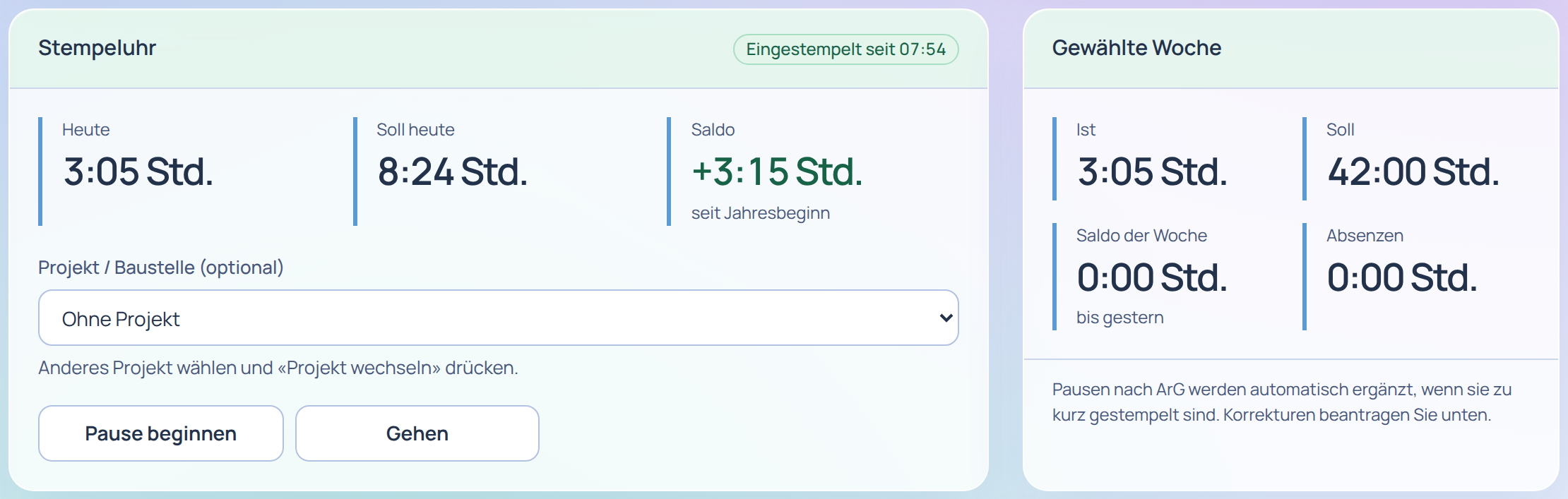
1. Web clocking. Employees clock arrival, breaks and departure through Time › Time recording (My time) or the homepage. Clocking before joining/after leaving is blocked. Define web/app/terminal permissions in clocking profiles, Time › Time recording › Rules and models. My time indicates web clocking restrictions.
2. Team terminal. A kiosk-mode tablet is shared; no personal data appears before login. Configure Time › Time recording › Terminals and badges and pair using a code.
3. Traceable corrections. Employees request retrospective changes with reasons in the weekly grid; originals remain and managers decide.
4. Labour checks. Profile settings automatically deduct or report missing Art. 15 breaks. Other warnings cover spans over 14 hours, rest below eleven, excessive daily work, night/Sunday/public-holiday work. Managers use Time › Time recording › Working hours, tab Labour Act (ArG) violations. Assess whether automatic breaks suit operations: they count breaks never clocked.
5. Balances. Employees/managers see actual, target and balance daily, weekly, monthly and year-to-date; absences/public holidays are credited.
6. Access log. Viewing, changing or exporting others’ times is logged. Authorised users view under Settings, filtering person, area and period; no export.
Unsupported: no dedicated Art. 73a waiver/73b simplified mode. Keep written agreements/year-end discussions outside time recording, e.g. personnel-file documents. Retention follows your practice; ensure Art. 73, para. 2’s five years.
Try the Demo or open a test account. See Overtime and excess hours and Employment contracts. Questions? See the Contact page.
Sources
- Federal Act on Work in Industry, Trade and Commerce (Labour Act, ArG, SR 822.11), Art. 1–3a, 9, 15a and 46, as at 1 September 2023: Fedlex (German original), accessed 26.10.2026.
- Ordinance 1 to the Labour Act (ArGV 1, SR 822.111), Art. 9, 73, 73a and 73b, as at 1 September 2024: Fedlex (German original), accessed 26.10.2026.
- SECO: Working time recording (in German), accessed 26.10.2026.
- SECO: Methods of working time recording (in German), version of 23 October 2018, accessed 26.10.2026.
- SECO: Guidance on ArGV 1 (in German), Art. 73 explanations November 2006, Art. 73a/73b February 2016, accessed 26.10.2026. Guidance expresses SECO’s interpretation, not a source of law.
This guide does not replace legal or tax advice. Information as at 26 October 2026.